STP Vs UTP

STP vs UTP: Understanding the Battle of Network Cables In the world of networking, choosing the right cable can make a significant difference in the performance and reliability of your network. Two common options that often cause confusion are Shielded…
Mesh Vs Star Topology

In networking, mesh vs star topology are two common configurations. Mesh topology provides high redundancy and reliability by connecting every device to each other, while star topology connects devices through a central hub or switch. This guide breaks down their…

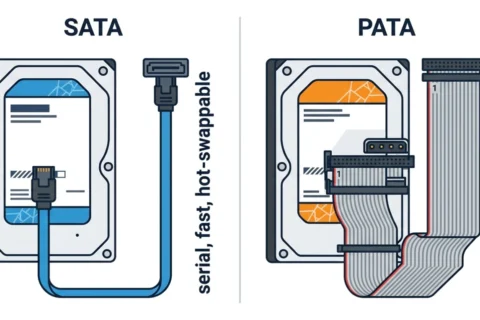
SATA vs PATA: Key Differences

The short answer SATA (Serial ATA) sends data one bit at a time over a thin cable, so it is fast, hot-swappable, and standard in modern computers. PATA (Parallel ATA) sends many bits at once over a wide ribbon cable,…

RISC vs CISC: Key Differences

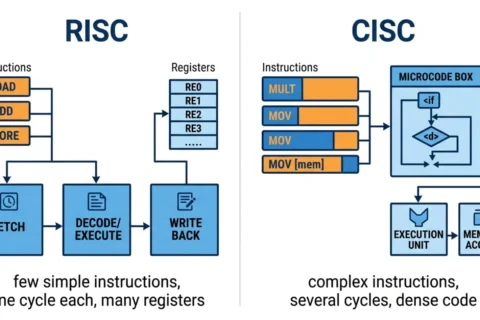
The short answer RISC (Reduced Instruction Set Computing) uses a small set of simple, fixed-length instructions that each run in about one clock cycle, so the design pipelines easily and suits low-power chips. CISC (Complex Instruction Set Computing) uses a…

SRAM vs DRAM: Key Differences

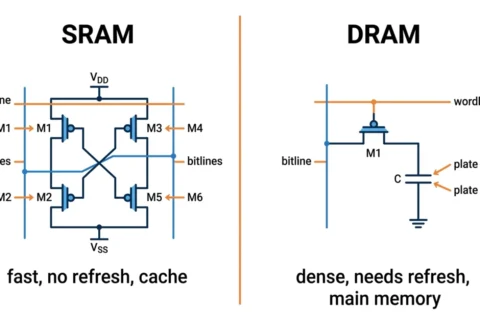
The short answer SRAM (Static RAM) and DRAM (Dynamic RAM) are both volatile memories, but they store a bit differently. SRAM holds each bit in a six-transistor flip-flop, so it is fast and needs no refresh, which suits cache memory.…

You cannot copy content of this page