Skip to content

DiffStudy

DiffStudy

  • Home
  • CS Fundamentals
    • Computer Networks
    • Computer Organization
    • Data Structures
    • DBMS
    • Operating System
    • Software Engineering
  • Web Development
    • Web Technology
  • Emerging Technologies
    • Emerging Technologies
    • AI
    • Neural Networks
  • Data Science
    • Data Analytics
    • Data Science
    • Home
    • Computer Programming
Inheritance vs Polymorphism: Key Differences

Inheritance vs Polymorphism: Key Differences

26 January 2025
0 Comments

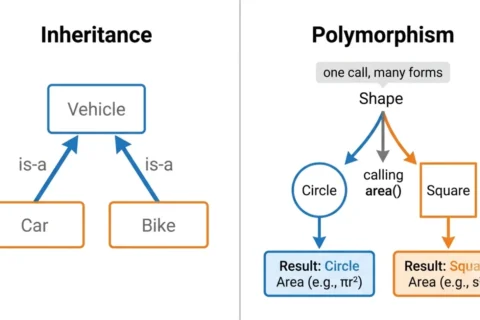
The short answer Inheritance lets one class reuse the fields and methods of another, forming an “is-a” hierarchy (a Car is a Vehicle). Polymorphism lets one interface take many forms, so the same call behaves differently depending on the object’s…

Shallow Copy vs Deep Copy: Key Differences Explained

Shallow Copy vs Deep Copy: Key Differences Explained

25 January 2025
0 Comments

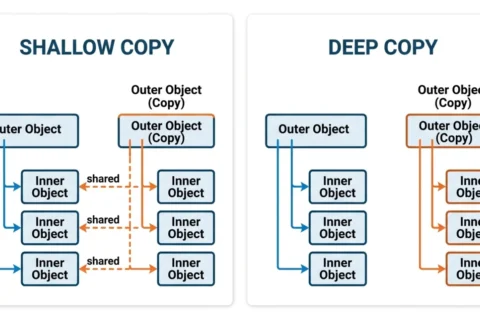
The short answer A shallow copy makes a new object but reuses the same nested objects, so the copy and the original still share their inner data. A deep copy duplicates everything, including every nested object, so the two are…

Compiler vs Interpreter: Understanding the Key Differences

Compiler vs Interpreter: Understanding the Key Differences

18 January 2025
0 Comments

In programming, Compiler vs Interpreter refers to two distinct methods of translating high-level code into machine-readable instructions. A compiler translates the entire code before execution, resulting in faster performance, while an interpreter processes the code line-by-line during execution. Understanding these…

map vs unordered_map in C++: Key Differences Explained

map vs unordered_map in C++: Key Differences Explained

16 January 2025
0 Comments

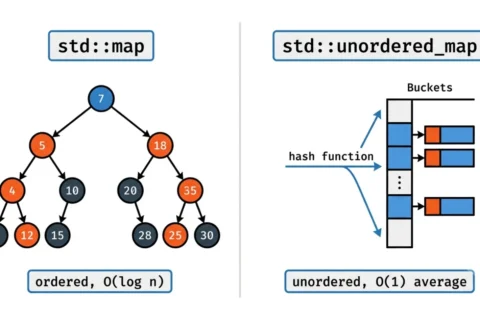
The short answer std::map is an ordered container built on a self-balancing binary search tree, so it keeps keys sorted and runs every operation in O(log n). std::unordered_map is a hash table, so it keeps no order but runs operations…

Structure vs Class in C++: Key Differences Explained

Structure vs Class in C++: Key Differences Explained

16 January 2025
0 Comments

In C++, understanding the distinction between structure vs class is essential for effective programming. This guide breaks down their differences, highlights their unique features, and explains when to use each for optimal coding practices. Structure in C++ A structure in…

Big O vs Big Omega vs Big Theta: Key Differences Explained

Big O vs Big Omega vs Big Theta: Key Differences Explained

15 January 2025
1 Comments

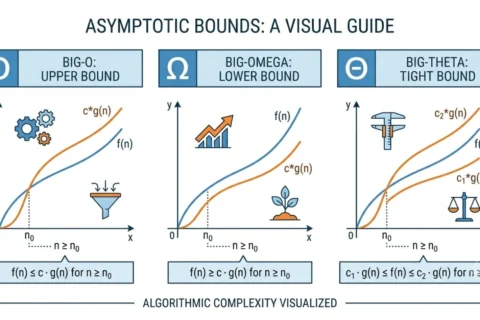
The short answer Big-O is the asymptotic upper bound, so it describes the worst case. Big-Omega is the lower bound, so it describes the best case. Big-Theta is a tight bound, meaning the function grows at the same rate from…

Understanding DDL vs. DML: Decoding Database Management

Understanding DDL vs. DML: Decoding Database Management

9 January 2025
0 Comments

When managing a database, it’s important to understand the difference between DDL and DML. These two concepts play essential roles in how data is organized and accessed. DDL is responsible for defining and altering the structure of the database, while…

Procedural vs Object-Oriented Programming (OOP vs POP): Key Differences

Procedural vs Object-Oriented Programming (OOP vs POP): Key Differences

8 January 2025
1 Comments

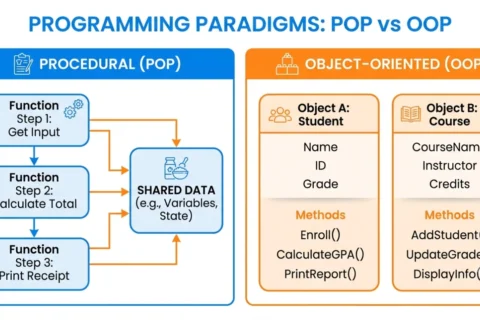
The short answer Procedural programming (POP) breaks a program into functions that run in sequence and act on shared data. It follows a top-down approach, as in C, Pascal, and FORTRAN. Object-oriented programming (OOP) models the program as objects, where…

Stack vs Heap Memory Allocation: Key Differences Explained

Stack vs Heap Memory Allocation: Key Differences Explained

7 January 2025
0 Comments

Efficient memory management relies on understanding stack vs heap memory allocation. The stack stores local variables and follows a Last In, First Out (LIFO) approach, while the heap dynamically allocates memory at runtime for flexible storage. This guide explores their…

Posts pagination

1 2

Next Page »

Recent Posts

  • MHA vs MQA vs GQA: Key Differences in Attention
  • Speculative Decoding vs Autoregressive Decoding: Key Differences
  • RoPE vs Absolute Positional Encoding: Key Differences
  • Encoder vs Decoder: Key Differences
  • Flow Control vs Congestion Control: Key Differences

Categories

  • AI
  • Automata
  • Blog
  • C
  • C Programming Software
  • C++
  • Cloud Services
  • Computer
  • Computer Graphics
  • Computer Networks
  • Computer Organization
  • Computer Programming
  • Cryptography
  • Cybersecurity
  • Data Analytics
  • Data Science
  • Data Structures
  • Databases
  • DBMS
  • Digital Electronics
  • Digital Technology
  • Emerging Technologies
  • Java
  • Latest Technology
  • Neural Networks
  • Operating System
  • Programming
  • Python
  • Software Engineering
  • SQL
  • Web Technology

You Missed

MHA vs MQA vs GQA: Key Differences in Attention
Speculative Decoding vs Autoregressive Decoding: Key Differences
RoPE vs Absolute Positional Encoding: Key Differences
Encoder vs Decoder: Key Differences

DiffStudy

Understand and compare key concepts in tech—from data structures to AI, OS, web technologies, and beyond—with clear explanations at DiffStudy.

Copyright © All rights reserved

  • About Us
  • Privacy Policy
  • Terms & Conditions
  • Contact Us
  • Cookie Policy (EU)
Search