RISC (Reduced Instruction Set Computing) uses a small set of simple, fixed-length instructions that each run in about one clock cycle, so the design pipelines easily and suits low-power chips. CISC (Complex Instruction Set Computing) uses a large set of complex, variable-length instructions that each do more work in fewer lines of code, so the design favours code density. In short, RISC pushes work onto the compiler for speed and efficiency, while CISC pushes work into the hardware for versatility.
RISC and CISC are the two main philosophies for designing a processor’s instruction set. Both appear in every computer organisation and GATE syllabus. Students often blur how each one runs an instruction and which real chips use which style.
The core question is simple. Should each instruction stay small and fast, or should it do a lot of work at once? RISC takes the first path, while CISC takes the second. This guide defines each design, compares them in detail, and shows where each one is used today.
If you are still mapping out the basics, it helps to know the difference between a microprocessor and a microcontroller first.
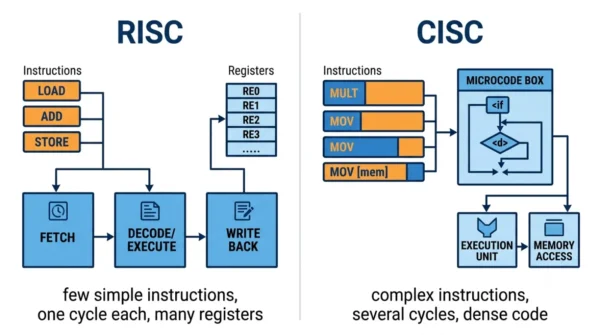
What is RISC?
RISC stands for Reduced Instruction Set Computing. The idea is to keep each instruction simple, short, and fast. So a RISC chip offers a small set of basic instructions, and each one runs in roughly a single clock cycle.
RISC also uses a load/store design. Only two instructions touch memory: load and store. Every arithmetic or logic step works on data already sitting in registers, and a RISC chip provides many of them. Because all instructions share one fixed length and format, the hardware decodes them quickly, and pipelining stays clean. As a result, the compiler does more of the work, turning each high-level line into several simple instructions.
Advantages of RISC:
- Fast, predictable execution, since each instruction is simple and fixed in length.
- Easy pipelining, so the chip overlaps several instructions at once.
- Lower power use, which is why phones and tablets favour it.
- A simpler, hardwired control unit that is cheaper to build.
Disadvantages of RISC:
- More instructions per task, so programs need more lines of code.
- Larger code size, because each step does less work.
- Heavier reliance on a smart compiler to keep the chip busy.
What is CISC?
CISC stands for Complex Instruction Set Computing. Here the goal is the opposite. Each instruction can do a lot, so a single line might load data, run an arithmetic step, and store the result together.
To support that, a CISC chip offers a large, rich instruction set with many addressing modes. Instructions vary in length and format, and many can read operands straight from memory rather than only from registers. Because one complex instruction replaces several simple ones, the code stays dense, which mattered greatly when memory was scarce and costly. However, that variety makes decoding harder, so CISC chips lean on a micro-programmed control unit that breaks each instruction into smaller internal steps.
Advantages of CISC:
- Dense code, so a program needs fewer instructions and less memory.
- Powerful single instructions that handle complex tasks directly.
- Simpler compilers, since the hardware already does much of the work.
- Strong backward compatibility with decades of older software.
Disadvantages of CISC:
- Higher cycles per instruction, because complex steps take longer.
- Harder pipelining, since instructions differ in length and timing.
- A complex control unit that costs more silicon and design effort.
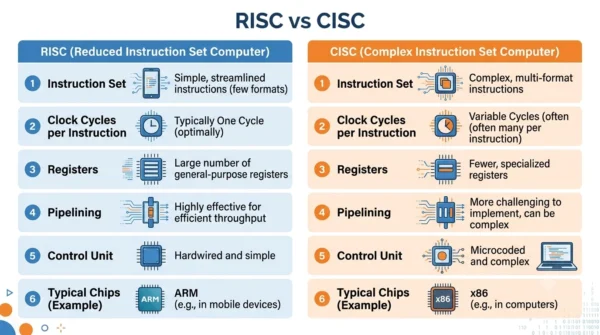
RISC vs CISC: Comparison Table
| Aspect | RISC | CISC |
|---|---|---|
| Full form | Reduced Instruction Set Computing | Complex Instruction Set Computing |
| Instruction set | Small set of simple instructions | Large set of complex instructions |
| Clock cycles | About one cycle per instruction | Several cycles per instruction |
| Cycles per instruction (CPI) | Lower | Higher |
| Memory access | Load/store only; compute uses registers | Memory operands allowed in instructions |
| Registers | Many general-purpose registers | Fewer registers (historically) |
| Instruction length | Fixed length, uniform format | Variable length, varied formats |
| Addressing modes | Few | Many |
| Pipelining | Easy | Difficult |
| Control unit | Hardwired | Micro-programmed |
| Decoding | Simple | Complex |
| Code density | Lower (more instructions) | Higher (fewer instructions) |
| Compiler workload | Higher | Lower |
| Power efficiency | Usually higher | Usually lower |
| Example chips | ARM, MIPS, RISC-V, SPARC | x86 (Intel, AMD), older VAX |
| Common use | Phones, tablets, embedded, Apple Silicon | Desktops, laptops, servers |
How RISC and CISC Run Instructions
The clearest way to see the gap is one small task: load two numbers, add them, and store the result.
On a RISC chip, that task needs several instructions. First two loads bring the numbers into registers. Then one add works on those registers. Finally a store writes the result back to memory. Each step is tiny and runs in about one cycle, so the chip pipelines them smoothly.
On a CISC chip, a single instruction can do the whole thing. One ADD can read both operands from memory, add them, and write the result back. That keeps the code short, yet the instruction itself takes several cycles, because the hardware unpacks it into smaller internal steps.
This trade-off explains the classic performance formula. CPU time depends on the instruction count, the cycles per instruction (CPI), and the clock period. RISC raises the instruction count but cuts the CPI, while CISC cuts the instruction count but raises the CPI. So neither wins on raw numbers alone, and the real result depends on the workload and the chip.
Real-World Chips
The two philosophies map onto chips you use every day.
- RISC examples: ARM powers almost every smartphone and tablet, and Apple’s M-series laptop chips are ARM-based. MIPS, SPARC, and PowerPC are other classic RISC families.
- CISC examples: the x86 and x86-64 chips from Intel and AMD run most desktops, laptops, and servers. The older VAX and Motorola 68000 were CISC too.
- RISC-V: this open, royalty-free RISC instruction set is growing fast in research, embedded boards, and new silicon. Despite the “V”, it is a pure RISC design, not a mix of the two.
So if you hold a phone, you almost certainly hold a RISC chip. If you sit at a typical desktop PC, you almost certainly use a CISC one.
The Modern Reality: The Line Has Blurred
Textbooks still teach RISC and CISC as opposites, yet modern chips borrow from both. The biggest example is x86. Outside, x86 still presents a complex CISC instruction set for backward compatibility. Inside, though, the chip decodes each CISC instruction into smaller, RISC-like steps called micro-operations, or micro-ops. The core then runs those simple micro-ops on a fast, pipelined engine.
In other words, a modern x86 CPU looks like CISC on the surface but works like RISC underneath. Meanwhile, RISC chips such as ARM have added richer instructions over time. As a result, the gap is now more about the instruction set than about the inner hardware. Still, the labels remain useful, because they describe the design goals and the trade-offs clearly.
When to Use RISC or CISC
You rarely pick an instruction set directly, yet the trade-off still guides real choices.
Choose a RISC platform when power and efficiency lead. Phones, tablets, wearables, and most embedded systems fit here, because simple instructions sip less energy. That is also why Apple moved its laptops to ARM-based silicon.
Choose a CISC platform when raw compatibility and a huge software base matter most. Desktops, workstations, and many servers fit here, since decades of x86 software simply run. So in practice the workload and the existing ecosystem usually decide, not the label on the chip.
Interview Questions
Frequently Asked Questions
Wrapping Up
RISC and CISC solve the same problem from opposite directions. RISC keeps each instruction simple and fast, while CISC makes each instruction do more at once.
Remember the simple rule: RISC means many small instructions and easy pipelining, and CISC means fewer, complex instructions and denser code. Today the line has blurred, since x86 runs RISC-like micro-ops inside a CISC shell. Still, the trade-off between simplicity and versatility is enough to answer most exam and interview questions on the two.
Related reading on DiffStudy:
- Microprocessor vs Microcontroller
- Hardwired vs Micro-Programmed Control Unit
- SRAM vs DRAM
- 32-bit vs 64-bit Operating Systems
- CS Fundamentals hub