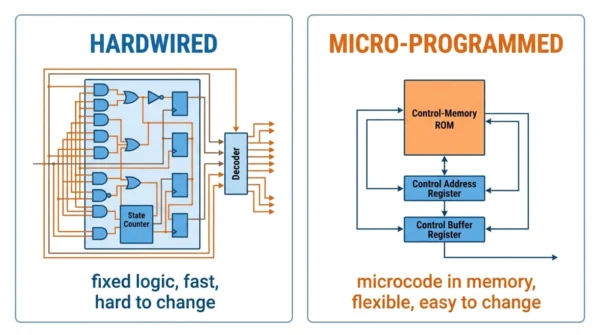
A hardwired control unit builds its control signals from fixed logic: gates, flip-flops, and a state counter. So it runs fast, but it resists change. A microprogrammed control unit stores those same signals as microinstructions in a control memory instead. So it runs slower, yet you can update it by rewriting microcode rather than hardware. The trade stays simple: hardwired buys speed, microprogrammed buys flexibility.
The control unit tells every other part of the CPU what to do. It reads each instruction, then fires the right signals in order. This job sits inside computer organization, one layer below computer architecture. Our computer architecture vs organization guide draws that line clearly.
So designers build a control unit one of two ways. A hardwired unit wires the logic straight into circuits. A microprogrammed unit stores that logic as code instead.
Some textbooks hyphenate it as micro-programmed; both spellings mean the same unit. Because this topic pairs with instruction-set design, start with the difference between RISC and CISC. It also pairs well with the basics of a microprocessor and a microcontroller.
What is a Hardwired Control Unit?
A hardwired control unit builds its control logic straight into fixed circuits. It uses logic gates, flip-flops, decoders, and a sequence counter or state register. Each instruction then maps to one fixed path through that hardware.
Because the signals come straight from gates, there is no memory to read. So the unit runs fast, with almost no delay. That speed suits real-time systems and high-performance cores, where every cycle counts.
The catch is rigidity: changing the design means rewiring the circuit itself. It is not impossible, only costly, since an engineer must redesign the logic rather than edit a line of code. For that reason, hardwired control suits RISC chips with small, fixed instruction sets. That single constraint explains most of the disadvantages listed below.
Advantages of a hardwired control unit:
- Very fast execution, because no control-memory access is needed.
- Low latency, so it fits real-time and high-performance systems.
- Energy efficient, since the streamlined logic does less work per step.
- A natural match for RISC and small fixed instruction sets.
Disadvantages of a hardwired control unit:
- Hard to modify, because any change means redesigning the circuit.
- Costly and slow to redesign once the layout is fixed.
- Difficult to scale to large or complex instruction sets.
- Decoding logic grows messy as the instruction count rises.
What is a Microprogrammed Control Unit?
A microprogrammed control unit stores its control logic as code instead of wiring it. Each control signal lives inside a special control memory, also called the control store. Every machine instruction maps to a small microprogram there, built from microinstructions.
When the CPU runs an instruction, the unit fetches that microprogram one step at a time. Each microinstruction then sets the control signals for one step. This extra memory access makes the design slower than hardwired control.
Still, it brings real flexibility, since you change behavior by editing microcode, not hardware. For that reason, microprogrammed control suits CISC chips with large, complex instruction sets. That same flexibility is why CISC families keep the design around today.
A microprogrammed control unit has a few key parts:
- Control Memory (CM): the store that holds every microinstruction.
- Control Address Register (CAR): the register that points to the next microinstruction.
- Control Buffer Register (CBR): the register that holds the microinstruction just read.
- Sequencer: the next-address logic that decides which microinstruction runs next.
Advantages of a microprogrammed control unit:
- Easy to modify, because you just rewrite the microcode in memory.
- Cheaper to update than rewiring fixed logic.
- Handles large, complex instruction sets with ease.
- Decoding stays simple and regular, even as instructions grow.
Disadvantages of a microprogrammed control unit:
- Slower, since each microinstruction needs a control-memory read.
- Needs extra control memory, which adds hardware and cost there.
- Higher latency per instruction, so it lags in time-critical work.
Where Microprogramming Came From
Microprogramming did not start as a CISC-era shortcut. Maurice Wilkes first developed the idea in 1951. He described it that year at the University of Manchester Computer Inaugural Conference.
The idea reached print two years later. Wilkes and Stringer published “Microprogramming and the Design of the Control Circuits of an Electronic Digital Computer” in the Mathematical Proceedings of the Cambridge Philosophical Society, April 1953. That paper remains the standard citation for the idea.
The first real machine followed a few years later. EDSAC 2 became operational in 1958, and it implemented Wilkes’s microprogrammed control directly. So the design behind most CISC processors began in the 1950s. It was an answer to wiring complexity, not a recent shortcut.
That date matters for one reason. Microprogramming predates the CISC era entirely, so it was never invented to serve complex instruction sets. Designers reached for it first to tame wiring complexity, and CISC later found it convenient.
Hardwired vs Microprogrammed Control Unit: Comparison Table
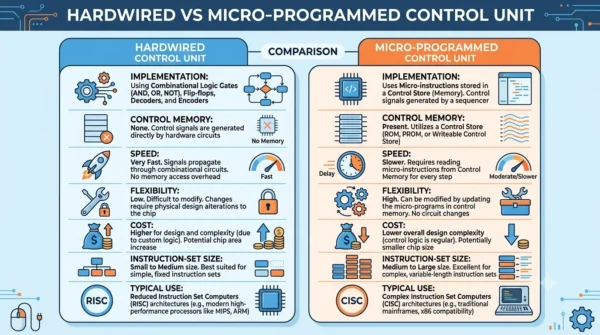
The table below lines up every difference in one place, aspect by aspect. Skim it first for a quick refresher, then read the sections below for the reasoning behind each row.
| Aspect | Hardwired Control Unit | Microprogrammed Control Unit |
|---|---|---|
| Implementation | Fixed hardware logic generates the signals | Software microcode generates the signals |
| Control memory | None used | Uses control memory (control store) |
| Signal source | Gates, flip-flops, decoders, sequence counter | Microinstructions read from control memory |
| Speed | Fast | Slow |
| Flexibility | Not flexible | More flexible |
| Ease of modification | Difficult to modify | Easy to modify |
| Decoding | Difficult to perform decoding | Easy to perform decoding |
| Instruction set size | Small instruction set is used | Large instruction set is used |
| Complex instructions | Difficult to handle | Easy to handle |
| Cost | More expensive to design and change | Less expensive to design and change |
| Architecture fit | Used in RISC | Used in CISC |
| Energy use | Lower, due to streamlined logic | Higher, due to control-memory access |
| Latency | Minimal, near real-time | Higher, per microinstruction |
| Best for | Real-time, high-performance systems | Evolving, complex instruction sets |
| Scalability | Hard to scale to many instructions | Scales well to many instructions |
| Design effort | High, since each instruction is wired | Lower, since logic lives in microcode |
| Control-store requirement | None | Requires a dedicated control memory |
| Next-step decision | State counter or sequential logic | Sequencer, driven by opcode and condition flags |
| First implemented in | No dedicated control-memory design existed | EDSAC 2, operational in 1958 |
| Origin | Evolved alongside digital logic design | Introduced by Maurice Wilkes in 1951 |
Two rows deserve extra attention for exams. The next-step decision often confuses students. A hardwired unit steps through states with a counter.
A microprogrammed unit instead lets a sequencer choose the address. It weighs the opcode and the condition flags to decide. The origin row matters too, since it gives every claim in this table a place to trace back to.
How They Generate Control Signals
The clearest way to see the gap is one small task: fetch an instruction, then add two registers. Both units raise the same control signals, yet they reach them differently. Watching both side by side is the fastest way to internalize the trade-off.
On a hardwired unit, a sequence counter steps through fixed states. At each state, decoders and gates read the opcode and assert the right signals directly. So the path from opcode to signal is pure wiring, and it resolves almost instantly. Adding a new instruction, though, means redesigning that logic.
On a microprogrammed unit, the control address register points into control memory. The unit reads that microinstruction into the control buffer register. Those bits become the control signals for the step.
Next, the sequencer computes the following address, and the loop repeats. Each step costs one control-memory read, which is why the design runs slower. Still, adding an instruction means writing a new microprogram, not rewiring a chip.
Inside a Microprogrammed Control Unit
A microprogrammed control unit runs on a tight loop of four parts. The diagram below traces that loop step by step. Once you can name each part, the rest of this guide reads much faster.
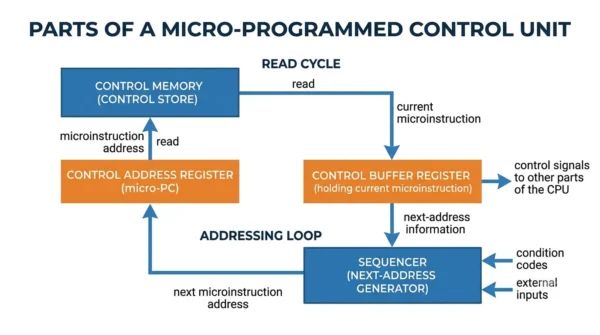
The control address register, or CAR, holds the address of the next microinstruction. It does not hold an instruction itself, only where to find one next. The control memory then returns the microinstruction stored at that address.
That microinstruction lands in the control buffer register, or CBR. Its bits become the control signals for the current step. A field inside that same microinstruction also feeds the sequencer, the logic that picks the next address.
The sequencer takes two inputs: the opcode from the instruction register, and the condition flags. Together, they decide where the CAR points next.
So the loop runs: CAR, control memory, CBR, then control signals. The CBR’s next-address field reloads the CAR through the sequencer.
Control memory is not cache, and it is not main memory. It sits inside the control unit itself, and it holds microinstructions, never program data. Our SRAM vs DRAM guide covers the memory that does hold program data. Our cache mapping guide covers how a cache places that data once it arrives.
Why a Microprogrammed Unit Is Always Slower
Every control step on a microprogrammed unit starts with a read. The unit must fetch a microinstruction out of control memory before it can act. That read happens on every single step, and it sits on the critical path.
A hardwired unit skips that read completely. Its signals come straight out of combinational logic, wired directly from the opcode. So there is no memory access to wait on, ever.
That one difference is the whole reason for the speed gap. It is not about clock rate, and it is not about a fixed multiplier. It comes down to whether a step pays for a memory read, or not. Once that idea clicks, the rest of the comparison becomes easy to predict.
Horizontal vs Vertical Microprogramming
Microprogrammed units come in two flavors, and the choice shapes microinstruction width. So it is worth knowing both well for exams.
Horizontal microprogramming uses a wide microinstruction, with roughly one bit per control signal. Because the bits map almost directly to signals, decoding stays minimal, and many signals fire together. The downside is size, since the control word grows long.
Vertical microprogramming uses a narrow microinstruction with encoded fields instead. A decoder then expands each field into the actual signals. So the control word shrinks, though parallelism drops and a decoding step appears.
A worked example makes the trade concrete. Take a control unit with 20 control signals to assert.
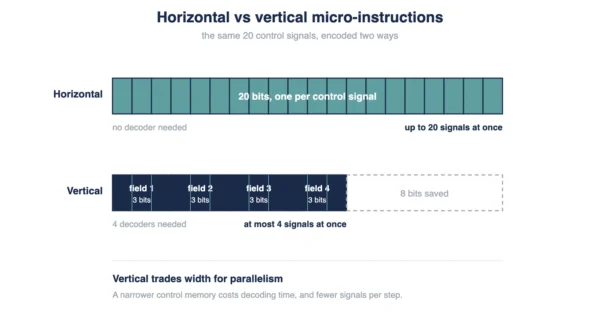
Horizontal microprogramming gives each signal its own bit. So the microinstruction needs 20 bits, one per signal. No decoder sits in the path, and up to all 20 signals can fire in a single step.
Vertical microprogramming groups those same 20 signals into 4 fields of 5 mutually exclusive signals each. Each field needs 3 bits. It must encode 5 signals plus a no-op, which is 6 codes, and 3 bits give 8. So the total comes to 12 bits, 8 bits narrower than horizontal.
That narrower word is not free. Vertical microprogramming needs 4 decoders, one per field, and at most 4 signals can fire in one step. Horizontal spends width to buy parallelism; vertical spends a decoder to buy compactness.
Neither format wins outright. Horizontal runs faster per step and skips decoding, but its control store grows wide. Vertical shrinks the control store, yet it needs decoding time and limits how many signals fire together. Exam questions often ask which one is better, and the honest answer is that it depends on the budget.
Nanoprogramming: A Control Store Inside the Control Store
Vertical microcode saves width, but it can repeat the same control pattern across many microinstructions. Nanoprogramming targets exactly that waste.
A nanoprogrammed design adds a second, wider control store. Vertical microcode indexes into that second store instead of driving signals directly, and the second store holds horizontal words. So the design saves space whenever many microinstructions share a pattern, at the cost of one extra lookup.
When both levels sit in the same design, the horizontal level is sometimes called nanocode. The Motorola 68000 is a documented example of a chip using microcode and nanocode together.
Nanoprogramming buys that space at a price. Each step now costs two lookups instead of one, so the control path grows longer still. That makes it a trade for space, never a route to speed.
When to Use Which Control Unit
Choosing a control unit depends on the application. So weigh speed against flexibility before anything else.
Choose a hardwired unit when raw speed and determinism lead. Real-time systems, high-performance cores, and RISC designs fit here, since each instruction stays simple and timing stays tight.
Choose a microprogrammed unit when the instruction set is large, or likely to change. CISC chips and evolving systems fit here, since editing microcode beats rewiring hardware.
Microprogrammed control is not obsolete, either. It is still how CISC designs, including x86 families, implement complex instructions. It shows up less in simple RISC cores, not because it failed, but because RISC rarely needs it. So calling it outdated confuses market share with capability.
Interview Questions
Frequently Asked Questions
Wrapping Up
Hardwired and microprogrammed control units solve the same job from opposite directions. A hardwired unit wires the logic into fixed circuits for speed, while a microprogrammed unit stores it as microcode for flexibility.
Remember the simple rule: hardwired means fast but rigid and RISC, while microprogrammed means flexible but slower and CISC. The speed gap always traces back to one thing: a microprogrammed step reads control memory, and a hardwired step never does. Horizontal and vertical microcode then trade word width against parallelism, and nanoprogramming trims that width further, at the cost of a second lookup.
So the choice between hardwired and microprogrammed control boils down to a balance between speed and adaptability. Knowing that trade-off, plus where each design came from, is enough to answer most exam and interview questions on the two.
Related reading on DiffStudy:
- RISC vs CISC
- Microprocessor vs Microcontroller
- Computer Architecture vs Organization
- SRAM vs DRAM
- Direct vs Associative vs Set-Associative Cache Mapping
- CS Fundamentals hub