Latency is the delay before data starts to arrive, measured in milliseconds, where lower is better. Throughput is the amount of data moved per second, measured in Mbps, where higher is better. So latency vs throughput is the difference between how fast it starts and how much gets through.
Latency and throughput both describe network and system performance, but they measure different things. People often mix them up, yet a connection can be strong on one and weak on the other.
This is a common networking and computer-architecture question, often asked as “throughput vs latency.” This guide defines each, compares them, explains how bandwidth fits in, and shows when each one matters.
It connects closely to how data is sent over a link, covered in our guide to simplex vs half-duplex vs full-duplex.
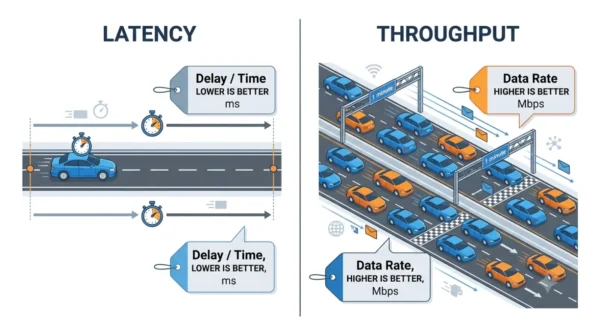
What is Latency?
Latency is the time delay for data to travel from source to destination. It answers the question, “how long before the first bit arrives?” It is usually measured in milliseconds (ms).
Often it is given as round-trip time, the delay for a request to reach the server and the reply to come back. The ping command measures exactly this. Lower latency is better.
Latency comes from distance, signal propagation, and processing or queuing along the way. A long or congested path adds delay, which is why a server far away feels slow even on a fast connection.
What is Throughput?
Throughput is the actual amount of data successfully delivered per unit of time. It answers a different question, “how much gets through?” It is measured as a data rate in bits per second, such as Mbps or Gbps.
Higher throughput is better. It reflects the real performance you get, not the theoretical maximum. Downloading a large file quickly depends on throughput.
Throughput is shaped by the available bandwidth, the latency, packet loss, and congestion. Even on a wide link, heavy loss or delay can drag the real throughput well below the maximum.
Latency vs Throughput: Comparison Table
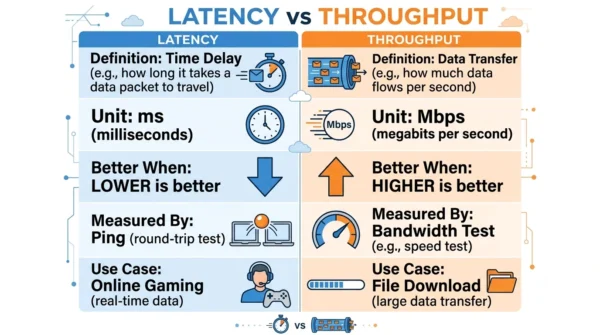
| Aspect | Latency | Throughput |
|---|---|---|
| Definition | Time delay for data to travel | Data delivered per unit time |
| Measures | Delay / time | Rate / volume |
| Unit | Milliseconds (ms) | Bits per second (Mbps, Gbps) |
| Better when | Lower | Higher |
| Question it answers | How soon does data arrive? | How much data gets through? |
| Highway analogy | Time for one car to cross | Cars passing per minute |
| Affected by | Distance, propagation, queuing | Bandwidth, latency, packet loss |
| Measured with | Ping / round-trip time | Bandwidth or speed tests |
| Direction | Often round-trip | Usually a one-way rate |
| Relation to bandwidth | Independent of capacity | Limited by bandwidth |
| Matters most for | Gaming, VoIP, trading | Downloads, streaming, backups |
| Goal | Minimise delay | Maximise data rate |
Latency vs Throughput vs Bandwidth
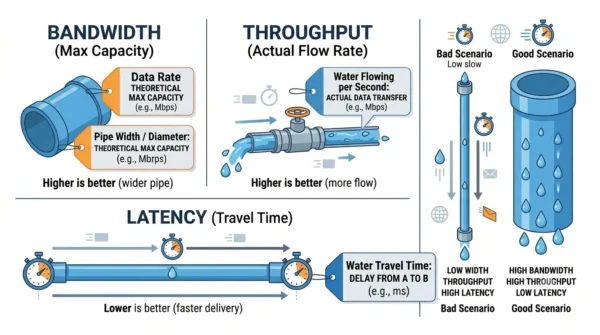
Bandwidth is often confused with throughput, so it helps to define all three with a water pipe.
- Bandwidth is the maximum capacity of the link, like the width of the pipe.
- Throughput is the actual flow you get, like the water really passing through.
- Latency is the travel time, like how long water takes to reach the other end.
So throughput can never exceed bandwidth, and a wide pipe still has delay if it is long. Bandwidth is the ceiling, throughput is the reality, and latency is the wait.
How Latency and Throughput Relate
Latency and throughput are linked but independent. A connection can have low latency yet low throughput, or high throughput yet high latency.
A satellite link is the classic example. It can carry a lot of data, giving high throughput, but the signal travels so far that latency is high. A short office cable is the opposite, with very low latency but limited throughput.
High latency can also drag throughput down on protocols that wait for acknowledgements, because each round trip adds delay before more data is sent.
When Each One Matters
Low latency matters when responsiveness is everything. Online gaming, video calls, and stock trading all need data to arrive quickly, even if the total volume is small.
High throughput matters when you move large amounts of data. File downloads, video streaming, and backups care about how much gets through, not the first-byte delay.
Many systems need both, so engineers tune for the one that limits their workload. Knowing which metric is your bottleneck is the first step to fixing it.
Interview Questions
Frequently Asked Questions
Wrapping Up
Latency and throughput are two sides of performance. Latency is the delay before data arrives, and throughput is how much data moves per second.
Remember the highway: latency is the time for one car to cross, and throughput is how many cars pass per minute. Optimise for low latency when speed of response matters, and for high throughput when volume matters.
Related reading on DiffStudy:
- Simplex vs Half-Duplex vs Full-Duplex
- Connection-Oriented vs Connection-Less
- OSI Model vs TCP/IP Model
- CS Fundamentals hub