The three data transmission modes differ in direction. Simplex sends data one way only (like a keyboard to a computer). Half-duplex sends both ways, but one at a time (like a walkie-talkie). Full-duplex sends both ways at the same time (like a telephone). So simplex vs half-duplex vs full-duplex is really a question of how many directions, and whether they work at once.
In data communication, the transmission mode defines how data flows between two devices. There are three modes: simplex, half-duplex, and full-duplex. The difference between them is simple once you picture the direction of traffic.
This is a favourite networking and GATE exam topic, usually asked as “define and compare simplex, half-duplex, and full-duplex.” This guide defines each mode, gives real examples, compares them in a table, and shows when each is used.
It pairs well with how data is timed on the wire, covered in our guide to synchronous vs asynchronous transmission.
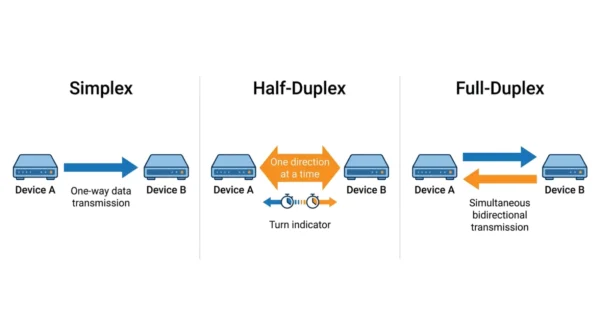
What is Simplex Communication?
Simplex is a one-directional transmission mode. Data flows in only one direction, from the sender to the receiver. The sender can only send, and the receiver can only receive; the roles never swap.
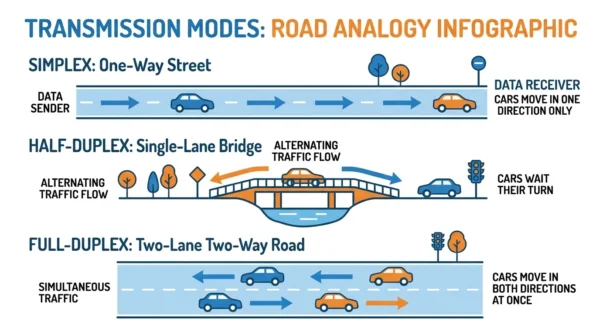
Because the whole channel serves a single direction, simplex uses the full bandwidth for that one path. It works well when no reply is ever needed. Think of a one-way street: traffic moves in one direction only.
Common examples are a keyboard sending keystrokes to a computer, a CPU sending output to a monitor, and television or radio broadcasting to receivers.
What is Half-Duplex Communication?
Half-duplex allows data to flow in both directions, but only one direction at a time. Each device can both send and receive, yet never simultaneously. While one side transmits, the other must wait and listen.
The classic example is a walkie-talkie: you press the button to talk, then release it to hear the reply, and you say “over” to signal your turn is done. A single-lane bridge is a good analogy, since cars cross one direction at a time.
Half-duplex uses the full channel for whichever direction is active. It suits cases that need two-way contact but not at the same instant.
What is Full-Duplex Communication?
Full-duplex allows data to flow in both directions at the same time. Both devices can send and receive simultaneously, with no waiting. It is the fastest mode for two-way communication.
A telephone call is the everyday example: both people can talk and listen at once. A two-lane, two-way road is the analogy, with traffic flowing both directions together.
To do this, the channel either splits into two separate paths or carries both directions at once, so full-duplex needs more capacity than the other modes. Modern wired Ethernet runs in full-duplex.
Simplex vs Half-Duplex vs Full-Duplex: Comparison Table
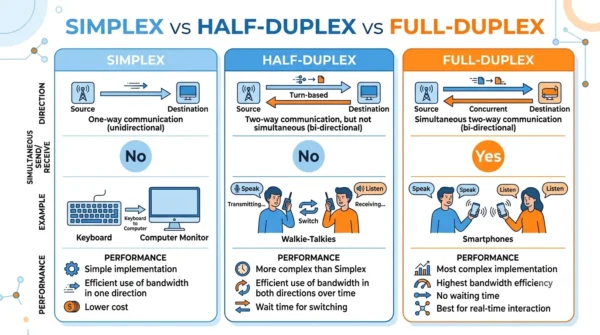
| Aspect | Simplex | Half-Duplex | Full-Duplex |
|---|---|---|---|
| Direction of data | One way only | Both ways, one at a time | Both ways, simultaneously |
| Send & receive together? | No | No | Yes |
| Data flow | Unidirectional | Bidirectional (alternating) | Bidirectional (simultaneous) |
| Performance / speed | Lowest (one-way) | Moderate | Highest |
| Bandwidth use | Full channel, one direction | Full channel, one direction at a time | Both directions at once |
| Can the receiver reply? | No | Yes, after the sender stops | Yes, anytime |
| Error feedback / acknowledgement | Not possible | Possible (turn-based) | Possible (real-time) |
| Channel efficiency | Low | Moderate | High |
| Cost | Lowest | Moderate | Highest |
| Example | Keyboard, TV/radio broadcast | Walkie-talkie, CB radio | Telephone, mobile call |
| Analogy | One-way street | Single-lane bridge | Two-way road |
| Typical use | Broadcasting, sensors | Push-to-talk radios | Real-time comms, Ethernet |
Real-World Examples of Each Mode
Examples make the three modes easy to remember.
- Simplex examples: keyboard to computer, mouse to computer, CPU to monitor, television and radio broadcast, a sensor sending readings to a system.
- Half-duplex examples: walkie-talkies, CB radios, and any push-to-talk system where you take turns to speak.
- Full-duplex examples: telephone and mobile phone calls, video calls, and modern wired Ethernet connections.
When to Use Each Mode
Use simplex when data only ever needs to travel one way, such as broadcasting or sending sensor data. It is simple and cheap, but the receiver can never reply.
Use half-duplex when both sides must communicate but not at the same time, and when sharing one channel saves cost. It also explains a common exam question: data transmission often needs half-duplex rather than simplex so the receiver can send back acknowledgements and error feedback, which simplex cannot do.
Use full-duplex when both sides need to send and receive at once with the least delay, such as phone calls and high-speed networks. It is the fastest but needs the most channel capacity.
Interview & Exam Questions
Frequently Asked Questions
Wrapping Up
The three transmission modes come down to direction. Simplex is one-way, half-duplex is two-way but alternating, and full-duplex is two-way at the same time.
Remember the examples and you will never mix them up: keyboard for simplex, walkie-talkie for half-duplex, and telephone for full-duplex. Choose simplex for one-way data, half-duplex for shared two-way contact, and full-duplex for the fastest two-way links.
Related reading on DiffStudy:
- Synchronous vs Asynchronous Transmission
- Connection-Oriented vs Connection-Less
- OSI Model vs TCP/IP Model
- CS Fundamentals hub