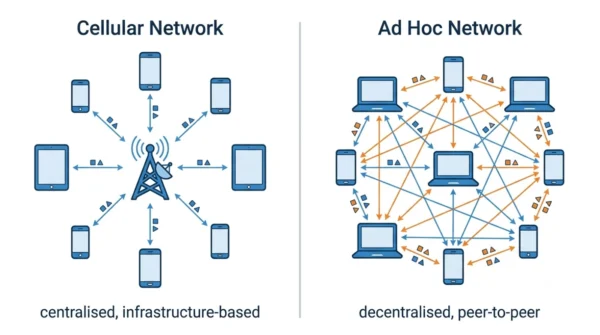
A cellular network uses fixed infrastructure, such as towers and base stations, to route communication, so it gives wide, reliable coverage. An ad hoc network has no central setup, so devices connect directly and relay data for each other. In short, cellular is centralised and infrastructure-based, while ad hoc is decentralised and peer-to-peer.
Cellular and ad hoc networks are two ways to connect wireless devices. Both appear in computer-networks and wireless syllabi, so students need to know how each one is structured and where each one fits.
The core split is infrastructure: a cellular network leans on fixed base stations, whereas an ad hoc network forms on the fly with no fixed setup. This guide defines each type, compares their architecture and uses in detail, and shows how to choose between them.
They build on wireless-link basics, so it also helps to know simplex vs half vs full duplex.
What is a Cellular Network?
A cellular network divides a large area into smaller regions called cells. So each cell is served by a base station, which lets mobile devices communicate through radio waves. Because the network relies on fixed infrastructure, it powers mobile phone services with wide coverage and reliable connectivity.
Advantages of cellular networks:
- To begin with, widespread coverage and reliable connectivity.
- High-quality voice and data services.
- Professional network management and maintenance.
- Scales to millions of users.
- Standardised protocols ensure interoperability.
- Finally, it offers Quality of Service (QoS) guarantees.
Disadvantages of cellular networks:
- High infrastructure costs.
- Dependent on fixed infrastructure.
- Slow to deploy in remote areas.
- A base-station failure can be a single point of failure.
- Finally, limited flexibility for temporary deployments.
Key components:
- Base stations: fixed transmitters that cover specific areas.
- Mobile Switching Centres (MSC): control centres that manage call routing and handoffs.
- Core network: the backbone linking to the internet and other networks.
- Mobile devices: end-user kit like smartphones and tablets.
What is an Ad Hoc Network?
An ad hoc network is a decentralised wireless network where devices talk directly without fixed infrastructure. Crucially, each device acts as both a client and a router, so it forwards data for other devices. Because such networks form on demand, they suit dynamic, temporary settings like emergency or military use.
Advantages of ad hoc networks:
- To begin with, rapid deployment without infrastructure.
- Self-organising and self-healing.
- Cost-effective for temporary use.
- Flexible and adaptable to changing conditions.
- No dependency on a central system.
- Finally, it is well suited to emergency and disaster scenarios.
Disadvantages of ad hoc networks:
- Limited coverage and irregular connectivity.
- Higher power use on mobile devices.
- Security challenges from the distributed nature.
- Complex routing and bandwidth management.
- Finally, performance can drop as the network grows.
Types of ad hoc networks:
- MANETs (Mobile Ad Hoc Networks): mobile devices that move freely.
- WSNs (Wireless Sensor Networks): sensors that collect and relay data.
- VANETs (Vehicular Ad Hoc Networks): vehicles networking for traffic management.
- FANETs (Flying Ad Hoc Networks): drones or aircraft.
Cellular Network vs Ad Hoc Network: Comparison Table
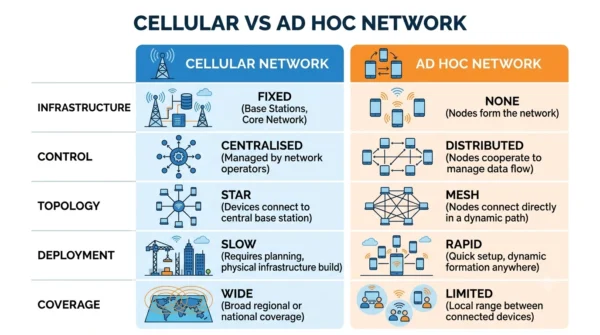
| Aspect | Cellular Network | Ad Hoc Network |
|---|---|---|
| Infrastructure | Fixed infrastructure | No fixed infrastructure |
| Control | Centralised (via base station) | Distributed (no base station) |
| Topology | Star | Mesh |
| Switching | Circuit switching | Packet switching |
| Hops | Single-hop | Single and multi-hop |
| Deployment | Slow | Very rapid |
| Setup time | Large | Small |
| Connectivity | Stable | Irregular |
| Bandwidth reservation | Easier to reserve | Complex to reserve |
| Traffic design | Voice; guaranteed bandwidth | Best-effort data; shared channel |
| Frequency reuse | Geographic channel reuse | Dynamic, carrier-sense based |
| Maintenance | High cost | Self-organising, low cost |
| Links | Devices reach the infrastructure | Mostly wireless, end-to-end over multiple links |
Architecture and Protocols
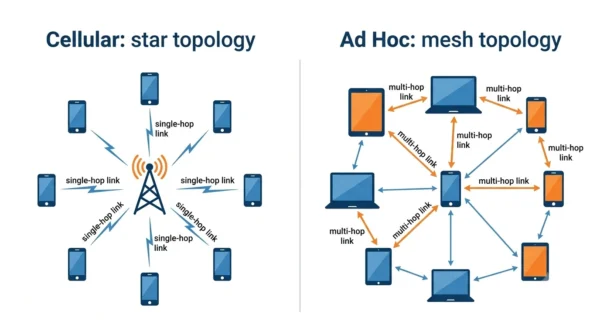
Network architecture. Specifically, cellular networks are built around central infrastructure, with base stations and a core network that link users to the internet. Ad hoc networks, by contrast, have no central control, so devices form the network spontaneously and depend on each other to pass data. As a result, ad hoc is more flexible but often less reliable.
Communication protocols. Cellular networks use standardised protocols such as GSM, CDMA, LTE, and 5G, which are built for wide-area, high-capacity coverage. Ad hoc networks instead use routing protocols like AODV, DSR, and OLSR, since these are tuned for dynamic, multi-hop links.
Signal coverage. For example, cellular networks reach across whole cities through well-placed base stations. Ad hoc networks cover a smaller range, set by each device’s transmit power, yet they extend reach by relaying over multiple hops.
Real-World Applications
Cellular network applications:
- Mobile communication: smartphones, tablets, and mobile internet.
- Internet of Things: smart-city infrastructure and connected vehicles.
- Emergency services: 911 calls and first-responder communication.
- Business: corporate mobile networks and remote-work connectivity.
- Entertainment: lastly, video streaming, mobile gaming, and social media.
Ad hoc network applications:
- Military: battlefield and tactical communication.
- Disaster response: communication when infrastructure is damaged.
- Environmental monitoring: sensor networks for climate and wildlife.
- Smart transport: vehicle-to-vehicle links for traffic optimisation.
- Events: lastly, temporary networks for conferences and meetings.
How to Choose the Right Network
Choose a cellular network when you need wide-area coverage and reliability. For example, a city-wide service or a long-term, large-scale deployment fits this model, because the budget can justify the infrastructure and many users need stable, high-quality voice and data. So cellular is the natural pick when connectivity must be permanent and dependable.
Choose an ad hoc network when fixed infrastructure is unavailable or impractical. For instance, a temporary or emergency setup suits it well, since you can deploy quickly, keep costs low, and lean on the network’s self-organising behaviour. In short, ad hoc wins when speed and flexibility matter more than wide coverage.
Future Trends and Technologies
Cellular. Indeed, cellular networks keep evolving with 5G and beyond, which bring ultra-low latency, massive connectivity, and faster mobile broadband. For example, 6G research, satellite integration, and network slicing all aim to push performance and flexibility further.
Ad hoc. Likewise, ad hoc networks are advancing, with AI-assisted routing, smarter algorithms, and better energy efficiency. Because edge computing and IoT are spreading, new ad hoc uses are appearing in smart cities and autonomous systems.
Hybrid. The future may also blend the two, so hybrid systems combine cellular reliability with ad hoc flexibility. In that case, devices could switch between a base station and a peer mesh as conditions change.
Frequently Asked Questions
Wrapping Up
Cellular and ad hoc networks both connect wireless devices, yet they take opposite approaches. A cellular network uses fixed infrastructure for reliable, wide-area coverage, while an ad hoc network connects devices directly for flexible, on-the-spot communication.
So weigh your coverage needs, budget, deployment speed, and reliability. A cellular network fits long-term, large-scale use, whereas an ad hoc network suits fast, infrastructure-less settings. Increasingly, hybrid systems blend the two, combining cellular reliability with ad hoc flexibility.
Related reading on DiffStudy: