An integrator is an op-amp circuit whose output follows the running integral (the accumulated area) of the input, so it smooths a signal and acts as a low-pass filter. A differentiator is the mirror circuit whose output follows the derivative (the rate of change) of the input, so it sharpens a signal and acts as a high-pass filter. In short, the integrator adds up a signal over time, while the differentiator tracks how fast it changes.
Integrators and differentiators are two classic op-amp circuits from analog signal processing. Both appear in every electronics and GATE syllabus, and both also sit inside the analog front-ends of digital and mixed-signal systems. Students often blur which one smooths a signal and which one sharpens it.
The core idea is calculus in hardware. One circuit performs integration, while the other performs differentiation, and those are inverse operations. This guide defines each circuit, shows the maths and the waveforms, compares them in detail, and explains when each one is used.
If you are still mapping out the basics, it helps to know the difference between a combinational and a sequential circuit first.
What is an Integrator?
An integrator produces an output that is the running integral of its input. In other words, it accumulates the input signal over time, like a bucket filling with water. So a steady input makes the output ramp up steadily, and the circuit gives a smooth, gradual response.
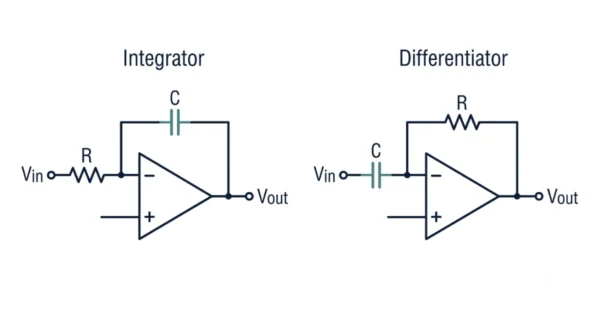
The standard op-amp integrator uses a resistor at the input and a capacitor in the feedback path. Its ideal output is Vout = −(1/RC) ∫ Vin dt. Because of that, a square wave in becomes a triangle wave out. The circuit also behaves as a low-pass filter, since its gain falls as the frequency rises, which is why it smooths signals and suppresses fast noise.
Advantages of an integrator:
- Smooths a signal and averages out fast noise, so the output is clean.
- Performs integration in hardware, which suits analog computing and control loops.
- Gives a gradual, predictable response to a changing input.
- Turns a square wave into a triangle or ramp for waveform generation.
Disadvantages of an integrator:
- A small DC offset accumulates over time and can drift the output to saturation.
- It usually needs a large feedback resistor to bound the DC gain.
- It responds slowly, so it cannot track sudden changes sharply.
What is a Differentiator?
A differentiator produces an output that is the derivative of its input. That is, it responds to the rate of change of the signal, like an electronic speedometer. So a fast change gives a large output, while a steady input gives almost none.
The standard op-amp differentiator simply swaps the parts: a capacitor at the input and a resistor in the feedback path. Its ideal output is Vout = −RC (dVin/dt). As a result, a triangle wave in becomes a square wave out, and a sharp edge produces a spike. The circuit acts as a high-pass filter, because its gain rises with frequency, so it emphasises fast transitions.
Advantages of a differentiator:
- Detects edges and sudden changes, so it is great for wave shaping.
- Performs differentiation in hardware for control and measurement.
- Turns a triangle wave into a square wave, the reverse of the integrator.
- Highlights the fast parts of a signal that other stages might miss.
Disadvantages of a differentiator:
- It amplifies high-frequency noise, since its gain grows with frequency.
- It can become unstable without a small series resistor to tame that gain.
- It reacts to nothing when the input is steady, so it ignores DC levels.
Integrator vs Differentiator: Comparison Table
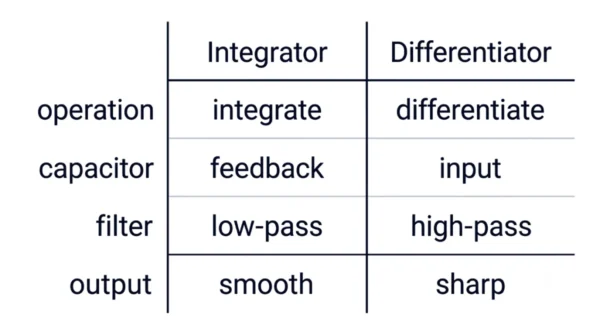
| Aspect | Integrator | Differentiator |
|---|---|---|
| Maths operation | Integration (accumulates the area) | Differentiation (tracks the rate of change) |
| Function | Accumulates input signals over time | Responds swiftly to changes in input signals |
| Transfer function | Vout = −(1/RC) ∫ Vin dt | Vout = −RC (dVin/dt) |
| Circuit (op-amp) | Resistor at input, capacitor in feedback | Capacitor at input, resistor in feedback |
| Filter behaviour | Low-pass filter (gain falls with frequency) | High-pass filter (gain rises with frequency) |
| Waveform effect | Square wave becomes a triangle wave | Triangle wave becomes a square wave; edges become spikes |
| Application | Signal smoothing and gradual responses | Rapid adjustments and frequency modulation |
| Adaptability | Ideal for applications requiring gradual responses | Crucial for applications demanding quick adjustments |
| Response to steady input | Ramps up (keeps accumulating) | Near zero (nothing is changing) |
| Noise behaviour | Averages out and suppresses fast noise | Amplifies high-frequency noise |
| Real-world use | Precision control in robotics, signal processing | Efficient frequency modulation in communication systems |
| Main challenge | Proper calibration and avoiding DC drift | Swift response without amplifying noise |
| Feedback element | The capacitor sits in the feedback loop | The resistor sits in the feedback loop |
| Relationship | Inverse of the differentiator | Inverse of the integrator |
Waveforms and the Maths
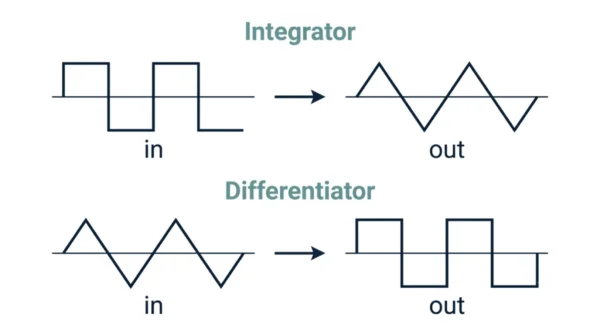
The clearest way to feel the difference is to watch the same waveform pass through each circuit.
Feed a square wave into an integrator. During each flat half of the square wave, the input is constant, so the output ramps at a steady slope. Therefore the square wave comes out as a triangle wave, because integrating a constant gives a straight ramp.
Now feed a triangle wave into a differentiator. Each rising or falling ramp has a constant slope, so its derivative is a constant level. Hence the triangle wave comes out as a square wave, which is exactly the reverse of the first case.
This mirror pattern is the whole point. Integration and differentiation are inverse operations, so the two circuits undo each other. In matrix-free terms, if the integrator turns A into B, then the differentiator turns B back into A.
Applications
Each circuit lands where its strength fits, so both appear across electronics.
- Integrator in control: control loops and analog computers use it to accumulate error over time, which gives precise, gradual correction in robotics.
- Integrator in signal processing: it smooths signals, reduces noise, and shapes waveforms, so it improves the quality of transmitted information.
- Differentiator in communications: it helps modulate frequencies and reshape pulses, which supports efficient data transmission.
- Differentiator in detection: it flags edges and sudden events, so it suits triggering and rate-of-change sensing.
So the integrator does the smoothing and accumulating, while the differentiator does the sharpening and edge-catching. In practice a real system often uses both on the same signal chain.
When to Use Which
You pick the circuit by asking what you want from the signal.
Choose an integrator when you need to smooth or accumulate. Averaging a noisy sensor, generating a ramp, or summing an error term all fit here, because each one wants a gradual, low-pass response. That is also why control loops lean on it.
Choose a differentiator when you need to catch change. Detecting an edge, measuring a slope, or emphasising fast transitions all fit here, since each one wants a high-pass response. So in short, integrate to calm a signal, and differentiate to react to it.
Interview Questions
Frequently Asked Questions
Wrapping Up
Integrators and differentiators solve opposite halves of the same problem. The integrator accumulates a signal and smooths it, while the differentiator tracks how fast a signal changes and sharpens it.
Remember the simple rule: the integrator has the capacitor in feedback, acts as a low-pass filter, and turns a square wave into a triangle; the differentiator has the capacitor at the input, acts as a high-pass filter, and turns a triangle back into a square. They are mathematical inverses, so knowing one gives you the other, which answers most exam and interview questions on the pair.
Related reading on DiffStudy:
- Combinational vs Sequential Circuits
- Half Adder vs Full Adder
- Frequency Modulation vs Amplitude Modulation
- CS Fundamentals hub