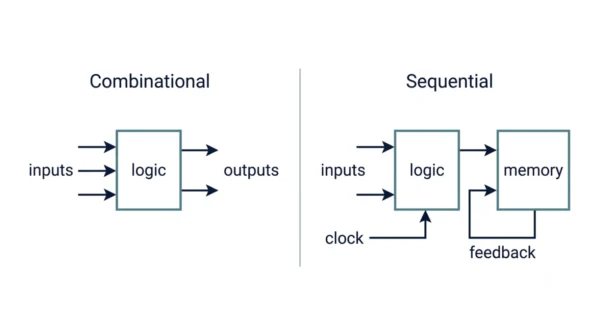
A combinational circuit produces an output that depends only on the current inputs. So it has no memory, no feedback, and needs no clock. A sequential circuit produces an output that depends on the current inputs and the stored past state. Therefore it has memory (flip-flops), uses feedback, and is usually driven by a clock. In short, a sequential circuit is just combinational logic plus memory.
Combinational and sequential circuits are the two building blocks of every digital system. Both appear in every digital logic and GATE syllabus. Yet students often blur the one fact that splits them: does the output remember the past, or not?
The combinational kind reacts only to what is on its inputs right now. The sequential kind also remembers where it has been. Because of that memory, sequential circuits can count, store, and follow a sequence of steps. This guide defines each type, compares them in detail, and shows where each one fits.
If you are still mapping out the basics, it helps to study a simple combinational block first, such as the half adder vs full adder.
What is a Combinational Circuit?
A combinational circuit is a digital circuit whose output depends only on the present inputs. It is built purely from logic gates, with no memory element inside. So the moment the inputs change, the output settles to a new value that is a pure Boolean function of those inputs.
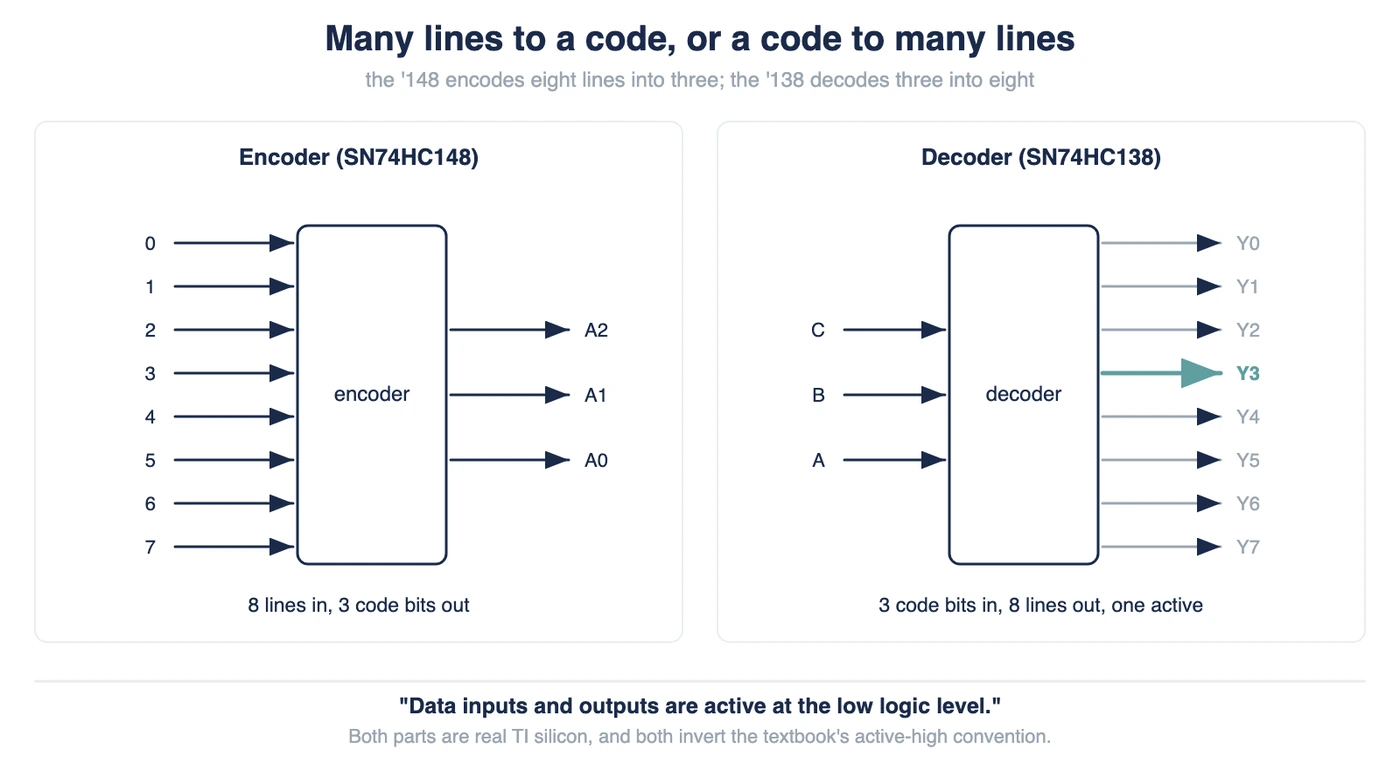
Think of it like a calculator key. Press the same buttons and you always get the same answer, because nothing from earlier is stored. As a result, the circuit has no historical context, no feedback path, and no clock. Common examples include adders, multiplexers, demultiplexers, decoders, encoders, comparators, and code converters.
Advantages of combinational circuits:
- Fast response, since the output appears as soon as the gates settle.
- Simple to design, because you only need a truth table and Boolean algebra.
- No clock or refresh, so timing is easy to reason about.
- Predictable, because the same inputs always give the same output.
Disadvantages of combinational circuits:
- No memory, so the circuit cannot store data or remember past inputs.
- Cannot count, sequence, or hold a state on its own.
- Glitches can appear briefly while several gate paths settle.
What is a Sequential Circuit?
A sequential circuit is a digital circuit whose output depends on the current inputs and the stored past state. To remember that state, it adds memory elements such as flip-flops or latches. Because of this, the same input can give different outputs, depending on what happened before.
A sequential circuit is really combinational logic plus memory wired with feedback. The stored state loops back into the logic, which then computes the next state. A clock usually times these updates, so the circuit moves forward one step on each clock pulse. Designers split sequential circuits into two classes. Synchronous circuits update only on the clock edge, while asynchronous circuits react as soon as an input changes. Common examples include flip-flops, latches, registers, counters, shift registers, finite state machines, and RAM.
Advantages of sequential circuits:
- They store data, so they can hold a value or remember past inputs.
- They can count, sequence, and follow a series of states over time.
- The clock keeps every part in step, which gives precise timing control.
- They form registers, counters, and memory, the heart of any processor.
Disadvantages of sequential circuits:
- Harder to design, since you need a state diagram and a state table.
- Slower, because each step waits for a clock edge.
- More complex, so they use more gates and more power than logic alone.
Combinational vs Sequential Circuits: Comparison Table
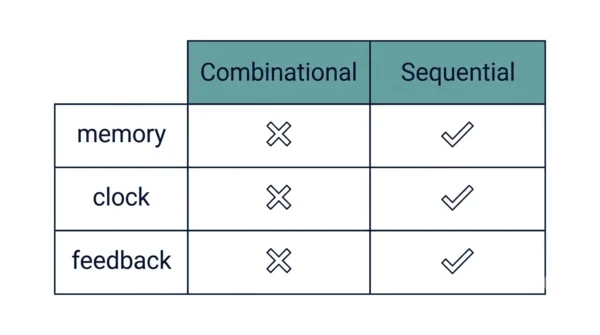
| Aspect | Combinational Circuit | Sequential Circuit |
|---|---|---|
| Output depends on | Only the present input | Present input and previous input |
| Memory | No memory element present | Memory element present |
| Feedback | No feedback path | Feedback path present |
| State storage | Cannot store any state | Can store a state |
| Clock | Clock independent | Clock dependent |
| Triggering | Needs no triggering | Needs triggering |
| Timing | Time independent | Time dependent |
| Speed | Fast | Slower |
| Building blocks | Logic gates only | Logic gates plus flip-flops |
| Design effort | Easy to design | Harder to design |
| Design tools | Truth table and Boolean algebra | State diagram and state table |
| Used for | Boolean algebra and arithmetic operations | Storing data and counting |
| Sub-types | Single class only | Synchronous or asynchronous |
| Examples | Encoder, decoder, multiplexer, adder | Flip-flops, counters, registers |
| Typical role | Data path and arithmetic logic | Memory, control, and state machines |
How Combinational and Sequential Circuits Work
The clearest way to see the gap is to watch each circuit handle the same idea: turning an output on or off.
A combinational circuit answers from the inputs alone. Take a 2-to-1 multiplexer. Its output simply follows whichever input the select line points to right now. Change the inputs and the output changes at once, after a tiny gate delay. Nothing is remembered, so feeding the same inputs always returns the same result.
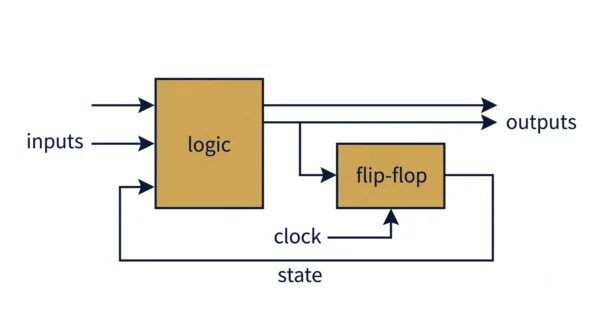
A sequential circuit answers from the inputs and the stored state. Take a simple toggle flip-flop that drives an LED. Press the button once and the LED turns on. Press the same button again and it turns off. The input is identical both times, yet the output differs, because the flip-flop remembers the last state. On each clock pulse, the circuit reads its current state, computes the next one, and stores it.
This is why a counter can climb 0, 1, 2, 3 from one repeated clock signal. Each tick feeds the stored count back into the logic, which adds one and saves the new value. A Mealy or Moore finite state machine works the same way, since both are sequential circuits built from logic and memory.
Applications of Combinational and Sequential Circuits
Each family lands where its strengths fit, so both appear throughout a digital system.
- Combinational in arithmetic: adders, multipliers, and ALUs compute results straight from their inputs, which suits real-time math.
- Combinational in routing: multiplexers, decoders, and encoders steer and translate data, for example in telecommunications and real-time signal processing.
- Sequential in storage: registers, RAM, and flip-flops hold data, so they handle memory and buffering.
- Sequential in control: counters, timers, and finite state machines run complex system control, where timing and a precise sequence of states matter.
So combinational blocks do the fast number-crunching, while sequential blocks remember and direct the flow. In practice a real chip mixes both on the same die.
When to Use Combinational or Sequential Circuits
You rarely pick one family in isolation, yet the trade-off still guides the design.
Choose a combinational circuit when the output should depend only on the present inputs. Arithmetic, data selection, and code conversion all fit here, because no past state is needed. So if the task is a pure function of its inputs, keep it combinational and simple.
Choose a sequential circuit when the system must remember something. Counting, storing data, and stepping through a protocol all need memory of the past. Therefore anything with a state, a count, or a clock-driven sequence belongs in the sequential camp. Most real designs combine both: combinational logic computes, and sequential logic remembers.
Interview Questions
Frequently Asked Questions
Wrapping Up
Combinational and sequential circuits solve digital problems from two angles. A combinational circuit maps the present inputs straight to an output, while a sequential circuit also remembers the past through memory and feedback.
Remember the simple rule: no memory means combinational, and memory means sequential. Each plays an indispensable role in the digital age, since combinational logic computes fast and sequential logic stores and sequences. Knowing that one contrast is enough to answer most exam and interview questions on the two.
Related reading on DiffStudy: