8085 vs 8086 Microprocessor: Key Differences
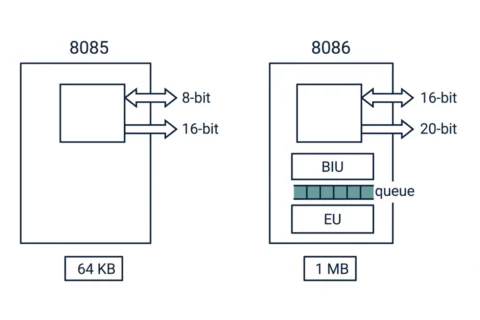
The short answer The 8085 is an 8-bit Intel microprocessor with an 8-bit data bus and a 16-bit address bus, so it reaches 64 KB of memory and runs near 3 MHz. The 8086 is a 16-bit chip with a…
In project management, Gantt Chart vs PERT Chart are two popular tools used for planning and scheduling. A Gantt chart provides a visual timeline of project tasks, while a PERT chart focuses on task dependencies and time estimation. This guide…
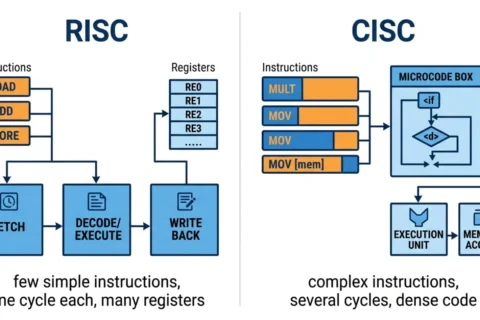
The short answer RISC (Reduced Instruction Set Computing) uses a small set of simple, fixed-length instructions that each run in about one clock cycle, so the design pipelines easily and suits low-power chips. CISC (Complex Instruction Set Computing) uses a…
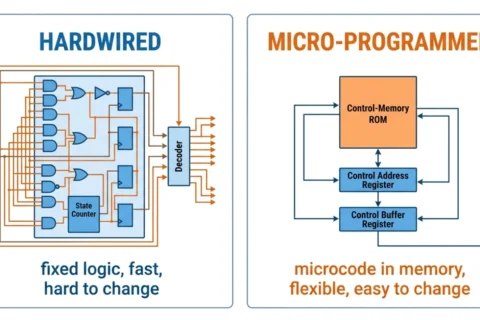
The short answer A hardwired control unit generates control signals with fixed sequential logic, such as gates, flip-flops, and a decoder, so it is fast but hard to change. A micro-programmed control unit stores those signals as microinstructions in a…
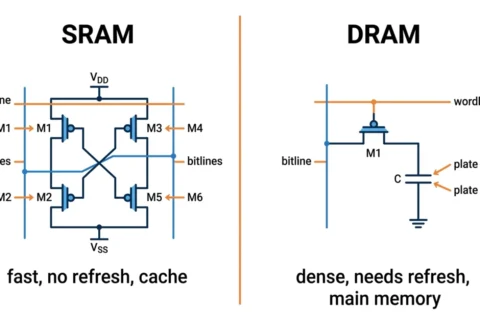
The short answer SRAM (Static RAM) and DRAM (Dynamic RAM) are both volatile memories, but they store a bit differently. SRAM holds each bit in a six-transistor flip-flop, so it is fast and needs no refresh, which suits cache memory.…
In the fast-paced world of technology, understanding the nuances between RAM (Random Access Memory) and ROM (Read-Only Memory) is paramount. These two integral components play a crucial role in the functionality of electronic devices, yet their distinctions often elude the…
You cannot copy content of this page