
OpenAI shut down Sora on March 24, 2026. It was costing $15 million per day to run and had generated $2.1 million in total lifetime revenue. Disney pulled a $1 billion investment. The most-hyped AI product of 2024 became the most expensive failure of 2026 — and it handed the AI video market to Runway, Kling, and Google Veo. These three tools have now carved out genuinely distinct positions: Runway Gen-4 leads on visual fidelity and professional workflow integration with an ELO benchmark score of 1,247.
Kling 3.0, released February 5, 2026, holds the #1 overall ELO score of 1,243 and pioneered multi-shot storyboard sequences with native 4K output. Veo 3.1 owns native audio generation — dialogue, sound effects, and ambient noise generated in a single pass — a capability that eliminates an entire post-production step that previously added 30–50% to production costs. The question is not which tool is best. It is which tool solves your specific production problem.
The AI Video Landscape After Sora
March 2026 is the most competitive moment in AI video history. The shutdown of Sora clarified the competitive dynamics that were building throughout 2025. Sora’s fundamental problem was unit economics: each 10-second clip cost approximately $1.30 to produce, the product was priced too low to cover it, and Disney’s $1 billion character licensing deal — which might have changed the equation — evaporated when OpenAI pulled the plug. The remaining platforms are, for the moment, building sustainable businesses.
The technology has crossed a meaningful threshold. In 2024, AI video meant short grainy clips with melting hands and physics that ignored reality. By February 2026, the top three models produce native 4K, synchronized audio in a single pass, multi-shot sequences with consistent characters across cuts, and camera work that rivals professional production for social media, product demos, and marketing content. The gap between AI-generated and traditionally produced video has narrowed to the point where the distinction is invisible to most audiences for most use cases. Average cost per minute of generated video fell 65% from 2024 to 2025. Industry adoption grew 300% year-over-year. Four of the top six models now generate audio natively — a capability that was available in exactly zero models in early 2025.
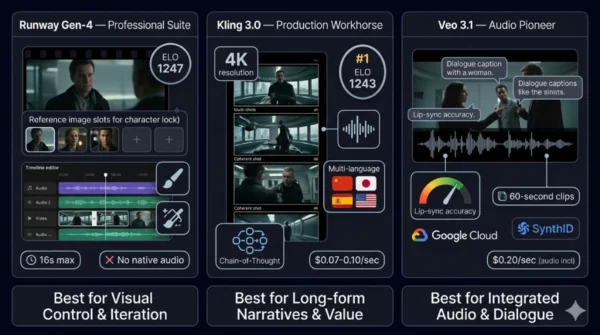
Runway Gen-4: The Professional Suite
Runway has positioned itself as the tool for professionals who need creative control rather than volume. Gen-4 and its updated Gen-4.5 release are not just video generators — they are complete creative production environments. The headline technical differentiator is World Consistency: the ability to lock a character’s visual identity using up to three reference images, maintaining that identity across multiple generated shots regardless of lighting, angle, or wardrobe. This solves the most frustrating problem in AI video production — the “flicker” between shots where a character’s face shifts or a prop changes geometry — and it solves it more reliably than any competing tool.
The platform bundles video generation with the tools you’d normally reach for after generation: inpainting to fix elements within a frame, outpainting to extend the frame, motion brush for controlling specific regions, camera path control, and colour grading. For studios and production teams integrating AI into existing workflows, Runway’s API is the most mature — it handles automation of repetitive generation tasks, batch processing, and custom pipeline integration at a level Kling and Veo don’t yet match. Gen-4.5 has pushed into 4K territory, though 1080p remains the sweet spot for most use cases in the current credit structure.
Where Runway Wins
- Character consistency across shots: World Consistency with up to three reference images is the most reliable identity-preservation system available — essential for narrative filmmaking where a protagonist must look identical across varied scenes
- Temporal consistency overall: ELO 1,247 reflects Runway’s lead in motion smoothness, logical scene transitions, and avoiding the mid-clip physics breakdowns that affect competitors
- Integrated editing suite: Inpainting, outpainting, camera path control, colour grading — you can fix and refine within Runway rather than exporting to a separate editor after every generation
- Production API maturity: The most battle-tested API for studios automating batch generation, custom pipeline integration, and production-at-scale workflows
- VFX pre-visualisation: Generating concept shots before committing to expensive CGI or live-action setups — a workflow where Runway’s quality and control beat the alternatives
- Storyboard and AI direction tools: Integrated storyboarding with AI-suggested camera angles and scene compositions — a full creative pipeline rather than a raw generation API
The Real Limitations
- No native audio: Runway outputs silent video. Every production that needs sound requires a separate audio pipeline — a meaningful disadvantage versus Kling and Veo in 2026 when native audio is becoming the standard expectation
- 16-second maximum length: The shortest clip ceiling of the three tools. Kling handles up to 15-second multi-shot sequences with longer options; Veo runs up to 60 seconds. For anything beyond a single scene, Runway requires stitching multiple clips
- Credit system complexity: 625 credits for $12/month sounds reasonable until you calculate that a single 10-second Gen-4 clip costs roughly 150–200 credits — meaning the Standard plan covers approximately 3–4 clips per month before you need to top up
- Expensive at volume: For social media teams generating 50+ clips per month, Runway’s per-clip economics are significantly worse than Kling’s subscription model
- Less photorealistic than Veo: On documentary-style footage requiring maximum verisimilitude, Runway’s rated 8.5/10 versus Veo’s 9.5/10 — the gap is visible in demanding use cases
- Support quality issues: Chatbot-only support for Standard/Pro plans, with slow resolution times that become a real problem for production teams under deadline
Runway Gen-4 at a Glance:
ELO: 1,247 (highest for visual fidelity). Max length: 16 seconds. Audio: None native — silent output. Resolution: 1080p standard; 4K with Gen-4.5. Pricing: Standard $12/month (625 credits); Pro $95/month (2,250 credits). A typical 5-second Gen-4 clip costs approximately $0.40–$1.00 depending on plan. Furthermore, Key feature: World Consistency — character identity lock across multiple shots using reference images. Best for: Narrative filmmakers, VFX pre-vis, studios needing character continuity and production suite integration.
Kling 3.0: The Production Workhorse
Kling 3.0, released February 5, 2026 by Kuaishou, arrived with the headline achievement that nobody else had shipped yet: Multi-Shot Storyboard. You define an entire sequence of shots — individual prompts, camera angles, transitions — and Kling generates them as a coherent narrative in a single batch, maintaining subject consistency across different camera positions and lighting conditions. If your first shot establishes a character holding a prop, Kling maintains that prop’s geometry and colour through the subsequent close-up and reaction shot. This was the capability that forced the rest of the market to respond, and it’s why Kling 3.0 holds the #1 overall ELO benchmark score of 1,243 despite Runway’s higher individual-clip fidelity rating.
The second major advance is its motion transfer feature, which went viral in early 2026: upload a reference video, Kling extracts the motion pattern, then applies it to a completely different subject. No competing tool does this automatically — Runway’s Motion Brush requires manual painting. The physics simulation has always been Kling’s strength (a 3D spatiotemporal attention architecture that handles cloth dynamics, human motion, and object interactions more naturally than transformer-only models), and 3.0 adds Chain-of-Thought reasoning that improves scene coherence across the generated frames. Native audio — dialogue, ambient sound, multi-character conversations — supports Chinese, Japanese, Spanish, and English variants. The audio quality has been described as occasionally muffled compared to Veo 3.1, but the multi-language breadth is unmatched.
Where Kling Wins
- Multi-Shot Storyboard: Define a complete sequence of shots in one prompt — Kling generates them with consistent characters, props, and lighting across all cuts. The 2026 breakthrough that redefined production workflow expectations
- Native 4K output: The only tool in the three-way comparison that ships native 4K without upscaling. Critical for productions delivering to large-format screens, cinemas, or high-DPI platforms
- Cost per clip: At approximately $0.07–0.10 per second, Kling 3.0 offers production-quality output at 44% less than Runway’s equivalent cost — the dominant choice for any workflow where volume matters
- Human motion quality: The 3D spatiotemporal attention architecture generates facial expressions, walking, gesturing, and complex body mechanics more naturally than competing models — rated best in category for content featuring people
- Motion transfer: Automatic motion extraction from reference footage and application to new subjects — a genuinely distinctive feature no other tool replicates from a single upload
- Multi-language audio: Native audio generation in Chinese, Japanese, Spanish, and English with multi-character dialogue and lip-sync — the widest language coverage in the market
The Real Limitations
- Audio quality: Multi-character audio in Kling 3.0 can sound muffled — notably less crisp than Veo 3.1’s native audio. For productions where audio quality is a primary requirement, Veo remains the better choice
- Chinese data law: All content is processed under Chinese data regulations. Kuaishou’s Terms of Service grant a worldwide royalty-free licence to use your content for AI training. Acceptable for personal and general marketing work; a real compliance concern for enterprises handling regulated data, client faces, or GDPR-sensitive material
- UI localisation for English speakers: Menu labels and error messages frequently appear in Chinese; export options require careful navigation. Billing practices — particularly intro pricing that increases at renewal and credits deducted for failed generations — have generated sustained user frustration
- Output-only: Kling generates and delivers — there is no integrated editing suite. Post-generation refinement requires exporting to a separate tool, unlike Runway’s all-in-one environment
- Kling 3.0 early access gating: As of April 2026, Kling 3.0 with its full feature set is available only to Ultra subscribers, with broader rollout still ongoing — standard subscribers may encounter the older 2.6 model
Kling 3.0 at a Glance:
ELO: 1,243 (#1 overall benchmark). Released: February 5, 2026 by Kuaishou. Max length: 15-second multi-shot sequences (up to 2 minutes in extended generation mode). Resolution: Native 4K. Audio: Multi-language (Chinese, Japanese, Spanish, English) — muffled quality reported. Pricing: ~$0.07–0.10/sec; Standard ~$6.99–10/month; free tier with 66 daily credits. Furthermore, Key features: Multi-Shot Storyboard, Chain-of-Thought reasoning, motion transfer, 4K native output. Best for: Social media creators, marketing teams, high-volume production, human-centric content.
Veo 3.1: The Audio Pioneer
Google DeepMind’s Veo 3.1 entered the market with one differentiator that no other tool could claim at launch: native audio generation. Not post-processed sound layered onto silent video. Not a separate TTS pipeline. A single model that simultaneously generates the video frames and the audio track — dialogue, sound effects, and ambient noise — as a unified output. A character speaking in a reverberant room gets natural reverb in the audio. A whispered conversation has appropriate proximity effect. Footsteps on gravel sound like gravel. This level of audio-visual coherence was previously only achievable in post-production, and Veo 3.1 is still the most accurate implementation of it across all competing models.
The technical architecture is also distinct in its approach to long-form content. Veo 3.1 generates up to 60 seconds of video — significantly longer than Runway’s 16-second maximum and Kling 3.0’s 15-second multi-shot cap — though most users report optimal quality in the 10–20 second range before consistency begins to degrade in the final frames. Access is currently US-based officially, with third-party platforms providing workarounds for international teams. Google AI Ultra ($249.99/month) bundles Veo access with Gemini 2.5 Ultra, Deep Research, and the broader Google AI stack — making the price comparison against standalone Runway or Kling plans somewhat misleading, since you are paying for an entire AI platform, not just video generation.
Where Veo Wins
- Native audio quality: Veo 3.1 sets the market standard for synchronized audio generation — dialogue, sound effects, and ambient noise coherent with the visual content in a single generation pass. The best lip sync accuracy of any model in the comparison
- Photorealism ceiling: Rated 9.5/10 for photorealism, matching Sora’s former benchmark and exceeding both Runway and Kling on documentary-style footage requiring maximum verisimilitude. The closest to indistinguishable-from-live-action available
- 60-second video length: The longest native generation window among the three tools — valuable for content that cannot be stitched without visible seams, product demonstrations, and narrative sequences
- Google ecosystem integration: Native connection to Google Drive, YouTube Studio, Vertex AI, and Google Ads — for enterprise teams already on Google Cloud, Veo 3.1 drops into existing workflows without additional infrastructure
- SynthID watermarking: Built-in content provenance verification — useful for enterprise teams needing content authenticity compliance and AI disclosure requirements under emerging regulations
- Best value fast mode: Veo 3.1 Fast at approximately $0.15/second with audio included is competitive with or cheaper than Kling’s audio-included pricing, making it strong value for audio-critical production
The Real Limitations
- Geographic restriction: Officially available only to US-based users — international teams access Veo 3.1 through third-party platforms (FAL.AI, other aggregators) rather than directly, adding a layer of dependency and potentially higher per-clip costs
- Highest headline price: Google AI Ultra at $249.99/month is the most expensive plan in the comparison, though the bundled Gemini 2.5 Ultra access partially justifies the cost for teams that would use it independently
- Quality degrades past 20 seconds: Despite the 60-second technical maximum, consistency noticeably degrades in the final frames of longer generations — limiting the practical length advantage over Runway and Kling for high-quality output
- Lip sync limitations on complex dialogue: While Veo 3.1 leads on audio overall, lip sync for rapidly changing or non-English dialogue shows visible inaccuracies — particularly noticeable on short high-speed speech and some Asian languages
- Google Vids interface constraint: The consumer-facing interface is designed for presentations rather than creative filmmaking — limited camera movement control, few aspect ratio options, and restricted shot composition versus Runway’s dedicated UI
- Free tier throttling: Output downloads are throttled on free tiers, creating bottlenecks for batch production workflows that need to iterate rapidly on generations
Veo 3.1 at a Glance:
ELO: 1,226. Developer: Google DeepMind. Max length: 60 seconds (optimal quality: 10–20 seconds). Audio: Native audio generation — best quality and lip sync in market. Pricing: $0.15–0.20/sec via API; Ultra $249.99/month (includes Gemini 2.5 Ultra); Lite at $0.05/sec for basic generation. Furthermore, Access: US-only officially; third-party access via FAL.AI and others. Key feature: Unified audio-video generation — single pass produces synchronized sound with video. Best for: YouTube content requiring sound, enterprise teams on Google Cloud, audio-critical productions, maximum photorealism.
Benchmarks and Quality Deep Dive
The ELO scoring system for AI video models — modelled on chess rating systems where models are ranked by head-to-head user preference comparisons — has become the industry standard for quality evaluation. Unlike self-reported metrics, ELO reflects real user preference across thousands of paired comparisons.
| Quality Dimension | Runway Gen-4.5 | Kling 3.0 | Veo 3.1 |
|---|---|---|---|
| Overall ELO Score | 1,247 (highest visual fidelity) | 1,243 (#1 overall) | 1,226 (audio benchmark leader) |
| Photorealism | 8.5/10 — excellent for stylised content; gaps on documentary realism | 8.5/10 — best for human subjects specifically; 247% improvement in image reference tasks (Kling O1) | 9.5/10 — market-leading photorealism; approaches live-action on demanding prompts |
| Motion fidelity | Excellent temporal consistency — best for narrative scene-to-scene coherence | Best human motion — fluid body mechanics, cloth dynamics, facial expressions | Good — cinematic camera movement; complex multi-person interactions can break |
| Native audio | None — silent output | Multi-language; can sound muffled | Best — dialogue + SFX + ambient in one pass; best lip sync |
| Character consistency | Best — World Consistency locks identity with reference images across unlimited shots | Strong — consistent across multi-shot sequences; object geometry maintained across angles | Good — reference image support in Veo 3.1; degrades on long-form generation |
| Physics simulation | Good — solid for most creative use cases | Best — 3D spatiotemporal attention; cloth, liquid, collision physics most realistic | Good — physically plausible without specialised physics architecture |
The Audio Generation Gap
The single biggest quality divide in the current market is not between any two video generation approaches — it is between models that generate audio natively and those that don’t. By early 2026, four of six major models generate synchronized audio in a single pass. Runway Gen-4 is the most significant holdout. This matters operationally: in traditional production, sound design (Foley, dialogue recording, ambient audio) adds 30–50% to post-production costs. A tool that eliminates that step entirely is not just more convenient — it structurally changes the cost model for social and advertising video production.
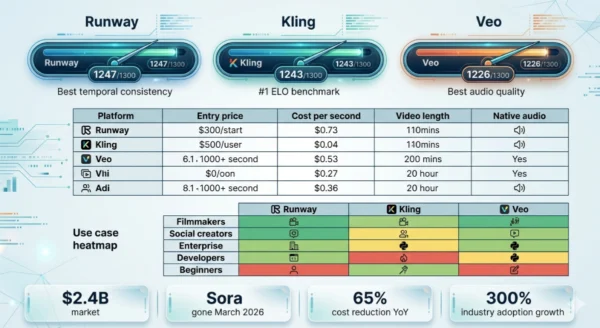
12 Critical Differences: Runway Gen-4 vs Kling 3.0 vs Veo 3.1
Aspect | Runway Gen-4 | Kling 3.0 | Veo 3.1 |
|---|---|---|---|
| ELO Benchmark | 1,247 — highest visual fidelity | 1,243 — #1 overall model | 1,226 — audio benchmark leader |
| Native Audio | None — silent output requiring post-production audio pipeline | Yes — multi-language (Chinese, Japanese, Spanish, English); can be muffled | Yes — best quality; dialogue + SFX + ambient in one pass; best lip sync |
| Maximum Video Length | 16 seconds — shortest of the three | 15-second multi-shot sequences; extended generation mode available | 60 seconds — longest; optimal quality at 10–20 seconds |
| Resolution | 1080p standard; Gen-4.5 pushing 4K | Native 4K — only model in comparison with native 4K output | 4K with upscaling; some artifacts on fine details |
| Character Consistency | Best — World Consistency locks identity with 3 reference images across unlimited shots | Strong — multi-shot sequences with consistent subject, props, and lighting across angles | Good — Ingredients-to-Video reference mode; consistency degrades on long generations |
| Pricing Entry | $12/month Standard (625 credits — approx. 3–4 Gen-4 clips); $95/month Pro | ~$6.99–10/month Standard; ~$0.07–0.10/sec; free tier 66 daily credits | $249.99/month Ultra (bundles Gemini 2.5 Ultra); $0.15–0.20/sec via API; Lite $0.05/sec |
| Cost per 5-Second Clip | ~$0.40–$1.00 (credit system) | ~$0.35–$0.50 | ~$0.75–$1.00 (with audio included) |
| Editing Suite | Full — inpainting, outpainting, camera path, colour grading, motion brush | None — generate and download; post-generation refinement requires external tools | Limited — Frames-to-Video and object insert/remove; UI designed for presentations not filmmaking |
| Ecosystem Integration | Strong API for studio automation; Adobe, production pipeline integrations | FAL.AI API access; no native enterprise integrations | Google Drive, YouTube Studio, Vertex AI, Google Ads — deepest enterprise integration |
| Multi-Shot Storyboard | Via reference images across sequential generations — manual, not automated batch | Yes — pioneered automated multi-shot with subject consistency in one generation pass | Limited — generates individual clips; multi-shot requires separate generations |
| Data Privacy | Standard US commercial terms; Privacy Mode available | Chinese data law; Kuaishou can use content for model training — compliance concern for regulated enterprise data | SynthID watermarking; Google Cloud data governance; US-only official access |
| Best For | Filmmakers, VFX pre-vis, narrative content, studios needing character continuity | Social media creators, high-volume marketing, human-centric content, budget-sensitive production | YouTube/audio-critical content, enterprise Google Cloud teams, maximum photorealism |
Use Cases and Workflow Matching
Choose Runway When:
- Narrative filmmaking — a protagonist who must look identical in five different environments across a short film or advertisement
- VFX pre-visualisation — testing a complex scene before committing to expensive CGI or live-action shooting; Runway’s quality ceiling and editing suite handle the back-and-forth iteration this requires
- Studio production pipelines — teams integrating AI generation into existing Adobe, Avid, or custom production workflows via API
- Animated series or campaign consistency — same characters across dozens of scenes where visual drift would break the production value
- Post-generation control — fixing a prop, adjusting colour temperature, or painting out an element after generation without re-generating the entire clip
Choose Kling When:
- Social media at volume — UGC-style content, TikTok and Instagram Reels, high-frequency content calendars where 50+ clips per month makes Runway’s economics unworkable
- Human-centric content — content featuring people, dancing, walking, speaking; Kling’s human motion quality and face consistency are rated best in category
- Multi-shot sequences without manual stitching — generating a coherent 5-shot sequence in one pass rather than generating and stitching five separate Runway clips
- Multi-language productions — bilingual or multilingual content targeting Chinese, Japanese, Spanish, or English-speaking audiences with accurate lip sync in each language
- 4K native output — productions delivering to large-format screens or platforms where native 4K is required and upscaling artefacts are unacceptable
Choose Veo When:
- YouTube content requiring sound — explainer videos, documentary-style content, tutorials where audio coherence with visual content is the primary quality signal
- Enterprise Google Cloud teams — organisations already running on Google Workspace and Vertex AI where Veo 3.1 integrates without additional infrastructure overhead
- Advertising productions requiring maximum photorealism — premium commercial work where the quality ceiling of 9.5/10 photorealism justifies the higher per-clip cost
- Content needing AI provenance compliance — SynthID watermarking addresses emerging regulatory requirements around AI content disclosure
- Long-form single-shot sequences — product reveals, walkthrough demonstrations, or presentations where 20–60 seconds of continuous high-quality generation without visible seams is the requirement
Creator Profile Match
| Creator Type | Primary Tool | Secondary Tool | Why |
|---|---|---|---|
| Indie filmmaker | Runway Gen-4 | Kling (high-volume shots) | Character consistency for narrative; Kling for B-roll volume at lower cost |
| Social media creator (daily content) | Kling 3.0 | Veo 3.1 (when audio matters) | $0.07/sec + free daily credits; best economics for 30+ clips/month |
| Marketing agency | Kling 3.0 | Runway (premium deliverables) | Volume in Kling; hero shots requiring character consistency in Runway |
| YouTube creator (talking-head/explainer) | Veo 3.1 | Kling (B-roll) | Native audio eliminates post-production sound step; Kling for visual B-roll |
| Enterprise content team (Google Cloud) | Veo 3.1 | Runway (character-critical) | Native Workspace integration; Runway for campaigns needing character lock |
| Developer / API integrator | Kling 3.0 | Runway (quality tier) | Kling 3.0 via FAL.AI has no waitlist; Runway API is more mature for pipelines |
Pricing and Market Data
AI Video Market
$2.4B
Total market opportunity post-Sora shutdown; industry adoption +300% YoY
Cost Reduction
65%
Average cost per minute of AI video dropped 65% from 2024 to 2025
Kling Videos
10M+
Videos generated by Kling since launch — fastest adoption in the market
Native Audio Models
4 of 6
Top AI video models generating native audio in 2026 — up from 0 in early 2025
Full Pricing Comparison
| Plan / Tier | Runway Gen-4 | Kling 3.0 | Veo 3.1 |
|---|---|---|---|
| Free tier | No free plan — paid subscription required | 66 daily credits — several standard 720p 5-second clips per day (watermarked) | Limited access via Google VideoFX and Google Labs for experimentation |
| Entry paid | Standard: $12/month (625 credits ≈ ~52 seconds Gen-4) | Standard: ~$6.99–10/month; Pro: ~$29–33/month (3,000+ credits) | Lite: ~$0.05/second via API; Fast: ~$0.15/second with audio |
| Professional | Pro: $95/month (2,250 credits ≈ ~187 seconds Gen-4) | Ultra: ~$99/month — full Kling 3.0 early access with all features | Standard Veo 3.1: ~$0.20/second with full native audio |
| Enterprise / Unlimited | Unlimited: custom pricing (note: has led to unexpected account suspensions — verify ToS) | API via FAL.AI: ~$0.07–0.10/second for batch production | Google AI Ultra: $249.99/month (bundles Gemini 2.5 Ultra, Deep Research, all Google AI) |
| Monthly cost for 50 clips (5 seconds each) | ~$100–$250 (depending on plan and credit top-ups) | ~$25–50 (Standard to Pro tier) | ~$75–100 via API; $249.99/month if on Ultra with other Google AI uses |
The Sora Vacuum: What Changed
Sora’s shutdown on March 24, 2026 is the defining market event of the year. The numbers that killed it: $15 million per day in compute costs, $2.1 million in total lifetime revenue, and downloads falling 67% from their November 2025 peak. Disney had signed a $1 billion investment deal and licensed over 200 characters from Disney, Marvel, Pixar, and Star Wars — that deal evaporated when OpenAI shut the product down. OpenAI says a replacement codenamed “Spud” is in development, but no public timeline has been confirmed.
The beneficiaries are unambiguous. Runway, Kling, and Veo each picked up displaced Sora users who needed a production-ready alternative immediately — and each beneficiary took a different segment. Many former Sora users who prioritized narrative coherence and overall quality have shifted to Runway. Those focused on accessibility and high-volume output have tended to move toward Kling. Users already embedded in Google’s ecosystem, meanwhile, have gravitated to Veo 3.1. In April 2026, Google further signaled its post-Sora market strategy by announcing pricing reductions for Veo 3.1 Fast.
Decision Framework
Three questions determine your starting point. First: does your output require audio? If yes, eliminate Runway immediately — the no-audio limitation is a production constraint, not a nice-to-have. Between Kling and Veo, choose based on volume (Kling cheaper) vs quality (Veo better lip sync). Second: do you need maximum character consistency across multiple shots? If yes, Runway’s World Consistency is genuinely the best implementation available. Third: what is your monthly volume? Below 20 clips, Runway’s credit system is manageable. Above 50 clips, Kling’s subscription economics are significantly more attractive.
Choose Runway If:
- You are building narrative content where the same character must be visually identical across multiple scenes
- You need post-generation editing — inpainting, colour grading, camera path adjustment — within the same platform
- You are producing VFX pre-visualisation before committing to expensive CGI or live shoots
- Audio will be handled separately in post-production and is not a generation priority
- You need a mature production API for studio pipeline automation
Best Use Cases for Kling:
- Volume matters — you are generating 50+ clips per month and need the economics to make sense
- Your content features people — Kling’s human motion and face consistency is rated best in category
- You need multi-shot sequences generated in a single pass without manual stitching
- Native 4K output is a delivery requirement
- Your content is multilingual and requires accurate lip sync in more than one language
Why Pick Veo:
- Your output absolutely requires synchronized audio and accurate lip sync — Veo 3.1 is the quality leader here
- You are a YouTube creator making explainer, documentary, or educational content where audio is part of the value
- You are an enterprise team already on Google Cloud — Veo integrates without additional infrastructure
- You need maximum photorealism — 9.5/10 photorealism is the current market ceiling
- You need AI content provenance compliance through SynthID watermarking
Quick Decision Table
| Your situation | Best choice |
|---|---|
| Making a short film — same protagonist across 20 shots | Runway Gen-4 (World Consistency) |
| 50 social media clips/month, budget under $50 | Kling 3.0 (Standard plan) |
| YouTube explainer video needing speech sync | Veo 3.1 (native audio) |
| 5-shot product reveal in one generation pass | Kling 3.0 (Multi-Shot Storyboard) |
| VFX previsualization for a feature film scene | Runway Gen-4 (editing suite + quality) |
| Enterprise team on Google Cloud | Veo 3.1 (Workspace integration) |
| Bilingual (Chinese + English) marketing content | Kling 3.0 (multi-language audio) |
| Maximum photorealism for premium brand video | Veo 3.1 (9.5/10 photorealism) |
| Developer building AI video app via API | Kling 3.0 via FAL.AI (no waitlist) or Runway API |
| Former Sora user needing immediate replacement | Runway (quality focus) or Kling (value focus) |
Frequently Asked Questions
It depends on what you’re measuring. For overall ELO benchmark score — the industry-standard preference rating from head-to-head user comparisons — Runway Gen-4.5 leads at 1,247 for visual fidelity and temporal consistency. Kling 3.0 holds the #1 overall position at 1,243 with particular strength in human motion and multi-shot coherence.
Veo 3.1 scores 1,226 and leads in photorealism (9.5/10) as well as native audio quality, delivering highly convincing synchronized dialogue and sound design. When it comes to cinematic narrative work that demands strong character continuity, Runway stands out as the quality leader. Kling, on the other hand, excels in rendering natural human motion, especially for scenes with people moving and speaking. For projects prioritizing absolute photorealism and precise audio accuracy, Veo 3.1 remains the top choice. In practice, most professional workflows combine at least two of these tools across different stages of production.
OpenAI shut down Sora on March 24, 2026. The economics were unsustainable: each 10-second clip cost approximately $1.30 to generate, Sora was burning $15 million per day in compute costs, and the product had generated only $2.1 million in total lifetime revenue. Downloads fell 67% from their November 2025 peak. Disney, which had signed a $1 billion investment deal and licensed over 200 characters from Disney, Marvel, Pixar, and Star Wars, exited the deal when Sora shut down.
OpenAI says a replacement product codenamed “Spud” is in development, but no launch timeline has been announced. The shutdown matters for tool selection because it validated the sustainable business models that Runway, Kling, and Google Veo have built — credit systems, subscription tiers, and API pricing that cover compute costs. It also freed up significant market share: former Sora users moved largely to Runway (quality focus), Kling (value focus), and Veo (audio/Google ecosystem focus) immediately after the shutdown.
No — Runway Gen-4 generates silent video. Audio is not natively produced during the generation process. For any production requiring synchronized audio, you have two options: generate video in Runway and add audio separately in post-production using traditional sound design tools, or use Kling 3.0 or Veo 3.1 for the audio-critical shots where native generation is required.
Runway does include text-to-speech and speech-to-speech tools within its editing suite for post-generation audio addition, but these are not the same as Veo 3.1’s native audio-video joint generation where the model produces coherent ambient sound and dialogue simultaneously with the video. The native audio models (Veo and Kling) produce audio that is semantically coherent with the visual content — a character in a reverberant room gets reverb, a whispered conversation has proximity effect — because the model understands both simultaneously. Post-generated audio layered onto Runway video cannot achieve the same level of audio-visual coherence without extensive manual work.
Multi-Shot Storyboard, introduced in Kling 3.0 (February 5, 2026), lets you define an entire sequence of shots — individual text prompts, camera angles, transitions — and generate them as a coherent narrative in a single batch while maintaining subject consistency across different camera positions. Previously, creating a multi-shot sequence in AI video required generating each shot individually, checking that the character looked the same across shots, regenerating until consistency was acceptable, and manually stitching the clips together. Each failed attempt burned credits, and even with careful prompting, character drift between shots was common.
Kling 3.0’s Multi-Shot Storyboard handles subject consistency automatically across the entire sequence: if Shot 1 establishes a character holding a specific prop, the close-up in Shot 3 maintains that prop’s geometry and colour. If Shot 1 establishes a lighting condition, subsequent shots maintain coherent lighting. This capability — which Kling O3 extends further — is why Kling 3.0 holds the #1 overall ELO benchmark score despite Runway’s higher individual-clip fidelity rating. Most professional reviewers consider Multi-Shot Storyboard the single most significant advance in AI video generation capability since native audio generation.
Officially, Veo 3.1 through Google AI Ultra and Google Labs is restricted to US-based users. International users access Veo 3.1 through third-party API aggregators — FAL.AI is the primary platform, offering Veo 3.1 access alongside Kling, Seedance, and other models at competitive pricing (often 30–50% cheaper than direct access for some configurations).
The international access via third-party platforms is functional for production use, though it adds a dependency layer and may mean you’re slightly behind the latest model updates compared to direct Google access. Google has signalled intention to expand Veo 3.1 availability geographically throughout 2026, and announced pricing reductions for Veo 3.1 Fast in April 2026 — consistent with a strategy of expanding market share internationally during the post-Sora window. Check Google Labs and Vertex AI for current availability in your region, and FAL.AI for the current state of international access.
Kling 3.0 is developed and operated by Kuaishou, a Chinese technology company, which means all content processed through Kling is subject to Chinese data law and Kuaishou’s Terms of Service. The key practical implication: by using the service, you grant Kuaishou a worldwide royalty-free licence to use your content for improving its AI systems.
For most personal creative work and general marketing content — promotional videos, social media clips, creative experiments — this is typically acceptable and the vast majority of Kling’s user base operates within these terms without issue. For enterprises, the concern becomes more specific: regulated data (healthcare, financial, legal), client faces without explicit consent for AI training, GDPR-sensitive material, or proprietary brand assets that the company does not want used in Kuaishou’s model training pipeline. If your production falls into any of these categories, evaluate Kling’s terms with your legal team before uploading sensitive content. The practical workaround many enterprises use is generating Kling content with synthetic subjects and generic scenarios while handling any regulated or proprietary content through Runway (US-based ToS) or Veo (Google’s data governance).
Yes — and this is increasingly how professional productions in 2026 operate. The most common hybrid workflow combines the strengths of two or three tools across different stages. A typical high-quality production workflow: design the character’s visual identity and storyboard the sequence in Runway (World Consistency for locking the protagonist’s appearance across all planned shots); generate high-volume shots and scene variations in Kling (most cost-effective per clip, best human motion physics, native 4K); add or refine audio elements in Veo 3.1 (for audio-critical hero shots requiring accurate lip sync) or in traditional post-production sound design.
The output of any AI video generator is a standard video file (MP4 or similar), making it fully compatible with any video editing software — there is no technical barrier to combining clips from Runway, Kling, and Veo in the same Premiere Pro or DaVinci Resolve timeline. The creative workflow requires prompt engineering adaptation for each platform (Runway prompts tend to be style-heavy and short; Kling responds better to explicit character descriptions; Veo benefits from scene-setting narrative) but this adaptation takes hours to learn, not weeks.
Several structural trends are reshaping the market between now and the end of 2026. Generation speed is expected to drop dramatically: current 1–3 minute wait times for a 10-second clip are projected to compress to 10–30 seconds by late 2026 as model inference optimisation improves.
This changes the creative workflow from “submit and wait” to something approaching real-time iteration. The native audio standard, currently held by Kling and Veo, is expected to reach Runway — Runway Gen-5 rumours suggest 2-minute support and native audio generation in the next major release. Resolution will continue climbing: native 4K is Kling’s differentiator now; by late 2026, it’s likely to be table stakes. The competitive floor is rising fast: models that were industry-leading in mid-2025 are now mid-tier in April 2026. OpenAI’s “Spud” replacement for Sora could reenter the market and restructure competition again if it ships on a more sustainable cost model. The $2.4 billion market opportunity will grow as studios, agencies, and independent creators adopt AI video into standard workflows — industry adoption was already up 300% year-over-year as of early 2026, and the Sora-driven market consolidation may accelerate that further.
The Verdict
The era of “just pick one AI video tool” is over. Runway, Kling, and Veo have diverged far enough in their capabilities that the right answer genuinely depends on what you are building. Runway is the professional creative suite — best quality control, best character consistency, best editing integration, no audio. Kling is the production workhorse — best cost economics, best human motion, best multi-shot automation, native 4K, multilingual audio. Veo is the audio pioneer — best native audio, best photorealism, best Google ecosystem fit, but US-restricted access and the highest headline price.
Runway Gen-4 Summary:
- ELO 1,247 — highest visual fidelity benchmark
- World Consistency — best character identity lock
- Full editing suite within the platform
- 16-second maximum; no native audio
- $12/month Standard; $95/month Pro
- Best for: filmmakers, VFX, narrative campaigns
Kling 3.0 Summary:
- ELO 1,243 — #1 overall model benchmark
- Multi-Shot Storyboard — 2026 production breakthrough
- Native 4K; multi-language audio
- $0.07–0.10/sec; most affordable at volume
- Chinese data law — enterprise caution advised
- Best for: social media, marketing volume, human content
Veo 3.1 Summary:
- ELO 1,226; 9.5/10 photorealism
- Best native audio — dialogue + SFX + ambient in one pass
- Best lip sync accuracy in the market
- Up to 60 seconds; optimal at 10–20s
- US-only officially; $249.99/month Ultra
- Best for: YouTube, audio-critical work, Google Cloud teams
Starting point for 2026:
Newcomers to AI video can begin with Kling 3.0’s free tier (66 daily credits), which offers enough room to explore what the technology can and cannot do before spending money. For projects where audio quality is important, it’s worth testing Veo 3.1 through Google Labs or FAL.AI before committing. Filmmakers or studios already experienced with AI generation will find Runway’s World Consistency system to be a genuinely craft-changing capability. Most serious productions in 2026 end up using at least two of these tools in the same pipeline — the combination of Runway’s character control, Kling’s volume economics, and Veo’s audio quality covers the full production spectrum that no single tool addresses completely.
Related Topics Worth Exploring
GPU vs TPU vs NPU for AI Workloads
Runway, Kling, and Veo all run on specialised AI hardware in the cloud. The $65.35 billion AI hardware market in 2026 is shaped by the same GPU clusters, TPU pods, and custom ASICs that power video generation. Understanding the underlying compute explains why Sora’s economics failed and why these three tools price the way they do.
Claude Code vs GitHub Copilot
Production studios integrating AI video generation into automated workflows use AI coding tools to build the glue code — API calls, video processing pipelines, batch generation scripts, and output management systems. The same generation that is transforming written code is transforming video production pipelines.
LangChain vs LlamaIndex
Advanced AI video production workflows in 2026 use LLM orchestration frameworks to manage prompt generation, model selection, output evaluation, and quality control across Runway, Kling, and Veo in the same pipeline. Understanding LangGraph and LlamaIndex unlocks multi-model AI video automation.
isn’t “is it good?” — it’s “is it good for the price?” Per DiffStudy’s April 2026 head-to-head, the per-second cost stack looks like this: Kling $0.07–$0.10, Sora 2 around $0.15, Veo 3.1
2026, the AI video market quietly split into three distinct camps and stopped being a fair fight. According to diffstudy.com, Kling 3.0 shipped on February 5 with the #1 overall ELO score of 1,243, native 4K output