A stack works in LIFO order — Last In, First Out. You add and remove from the same end (the top), like a pile of plates. A queue works in FIFO order — First In, First Out. You add at the rear and remove from the front, like a line at a counter. Both are linear data structures, so the real difference is simply which element comes out next: the newest for a stack, the oldest for a queue.
Stack and queue are the two most fundamental linear data structures in computer science, and almost every program you use relies on them somewhere. The browser back button uses a stack. The print spooler on your office printer uses a queue. Interviewers ask about them constantly, because choosing the right one shows you understand how order affects behaviour.
The two structures look similar — both store a sequence of elements and both grow and shrink at runtime. They differ in one rule: where elements enter and leave. That single rule changes how each one behaves, where it fits, and which problems it solves cleanly. This guide explains both from first principles, with operations, time complexity, code, a full comparison table, and the questions that come up in interviews and GATE.
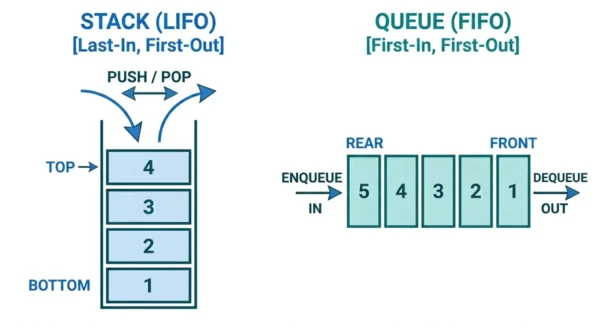
What is a Stack? (LIFO)
A stack is a linear data structure that follows the Last In, First Out (LIFO) principle. The element you add most recently is the element you remove first. Picture a stack of plates: you place each new plate on top, and you take the top plate first. Every insertion and deletion happens at one end, called the top.
A stack supports three core operations:
- push — add an element to the top
- pop — remove and return the top element
- peek (or top) — read the top element without removing it
Because all the action happens at one end, a stack is simple and fast. It powers function calls (the call stack), undo features, expression evaluation, and backtracking algorithms. Whenever a problem needs you to reverse something or return to the most recent step, a stack fits naturally.
What is a Queue? (FIFO)
A queue is a linear data structure that follows the First In, First Out (FIFO) principle. The element you add first is the element you remove first. Picture a line at a ticket counter: the person who arrives first gets served first. A queue uses two ends — you add at the rear and remove from the front.
A queue supports these core operations:
- enqueue — add an element at the rear
- dequeue — remove and return the front element
- front (or peek) — read the front element without removing it
Queues preserve order, so they suit any system that must process requests fairly in arrival sequence. CPU scheduling, print spooling, message buffers, and breadth-first search all rely on queues. If the rule is “first come, first served,” the right structure is a queue.
Operations & Time Complexity
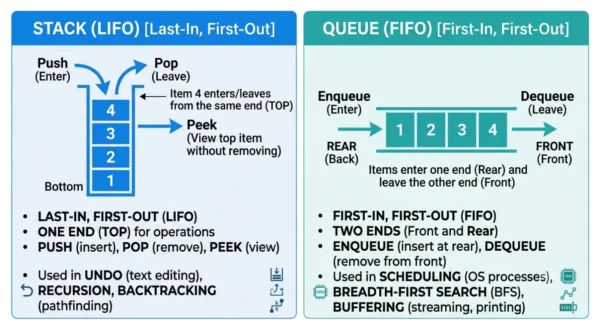
Both structures keep their core operations at O(1) — constant time — because each one touches only a single end. That speed is exactly why they are so widely used.
| Operation | Stack | Queue | Time |
|---|---|---|---|
| Insert | push (top) | enqueue (rear) | O(1) |
| Remove | pop (top) | dequeue (front) | O(1) |
| Read next | peek (top) | front | O(1) |
| Search | O(n) | O(n) | O(n) |
| Space | O(n) | O(n) | O(n) |
Searching takes O(n) in both, because you may have to scan every element. In practice you rarely search a stack or queue directly — you use them for their ordering, not for lookup.
Stack vs Queue: Key Differences
| Aspect | Stack | Queue |
|---|---|---|
| Ordering | LIFO — Last In, First Out | FIFO — First In, First Out |
| Ends used | One end (top) | Two ends (front and rear) |
| Insert operation | push — at the top | enqueue — at the rear |
| Delete operation | pop — from the top | dequeue — from the front |
| Which element leaves first | The newest | The oldest |
| Pointers needed | One (top) | Two (front and rear) |
| Reversal | Naturally reverses order | Preserves order |
| Variants | Single type | Circular, double-ended (deque), priority |
| Typical uses | Undo, recursion, backtracking, expression evaluation | Scheduling, BFS, buffering, print spooling |
| Analogy | Pile of plates | Queue at a counter |
Code Examples
The snippets below show the core operations of each structure in plain, readable form.
Stack (LIFO)
class Stack:
    def __init__(self):
        self.items = []
    def push(self, x):       # add to the top
        self.items.append(x)
    def pop(self):           # remove from the top
        return self.items.pop()
    def peek(self):          # read the top
        return self.items[-1]

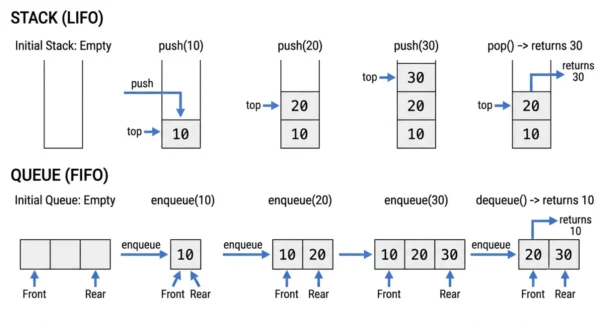
s = Stack()
s.push(10); s.push(20); s.push(30)
print(s.pop())   # 30  -- newest leaves first (LIFO)
print(s.peek())  # 20
Queue (FIFO)
from collections import deque

class Queue:
    def __init__(self):
        self.items = deque()
    def enqueue(self, x):    # add at the rear
        self.items.append(x)
    def dequeue(self):       # remove from the front
        return self.items.popleft()
    def front(self):         # read the front
        return self.items[0]

q = Queue()
q.enqueue(10); q.enqueue(20); q.enqueue(30)
print(q.dequeue())  # 10  -- earliest leaves first (FIFO)
print(q.front())    # 20
Note the queue uses deque rather than a plain list. Removing from the front of a Python list is O(n) because every element shifts, while deque.popleft() stays O(1). That choice keeps the FIFO operations fast.
Types of Queues
A stack has a single form, but a queue comes in several useful variants:
- Simple (linear) queue — the basic FIFO queue: insert at the rear, remove from the front.
- Circular queue — the rear wraps back to the start, reusing freed slots so no space is wasted.
- Deque (double-ended) — insertion and deletion are allowed at both ends, so it can act as a stack or a queue.
- Priority queue — elements leave by priority rather than arrival order. See priority queue time complexity.
Real-World Applications
Stack — function call management (the call stack), undo and redo in editors, browser back-button history, expression evaluation and parsing, and backtracking such as maze solving and DFS.
Queue — CPU and disk scheduling, print-job spooling, message queues and request buffering, breadth-first search in graphs, and handling shared resources fairly.
When to Use Which
The choice comes down to which element you need next. Choose a stack when the most recent item matters most — undo history, nested function calls, or any task that unwinds in reverse. Choose a queue when fairness and arrival order matter — scheduling, buffering, or level-by-level traversal.
A quick test helps in interviews. If the problem says “reverse,” “backtrack,” or “most recent,” reach for a stack. If it says “in order,” “fair,” or “level by level,” reach for a queue. Both sit among the linear data structures, and you can build either one on top of an array or a linked list.
Interview Questions on Stack vs Queue
Can you implement a queue using two stacks? Yes, and it is a classic question. Use one stack for enqueue and another for dequeue. To dequeue, if the second stack is empty, pop every element from the first into the second, which reverses the order and exposes the oldest element on top. Each element moves at most twice, so the amortised cost stays O(1).
Why does BFS use a queue and DFS use a stack? Breadth-first search explores level by level, so it needs the oldest discovered node next — that is FIFO, a queue. Depth-first search dives down one path and backtracks, so it needs the most recent node next — that is LIFO, a stack (or recursion, which uses the call stack).
What is the difference between peek and pop? peek reads the next element without removing it, so the structure is unchanged. pop reads and removes it, so the size shrinks by one. The same distinction applies to a queue, where front reads and dequeue removes.
Frequently Asked Questions
Wrapping Up
Stack and queue store a sequence the same way, yet one rule sets them apart: a stack returns the newest element, and a queue returns the oldest. Remember LIFO for the stack and FIFO for the queue, and the rest follows — the operations, the pointers, and the problems each one solves.
When you meet a new problem, ask which element should come out next. That answer points you straight to the right structure, and it explains why both appear in nearly every system you use.
Related reading on DiffStudy:
- Stack vs Array and Array vs Linked List
- Stack vs Heap Memory Allocation
- Linear vs Non-Linear Data Structures
- Graph vs Tree and DFS vs BFS
- CS Fundamentals hub