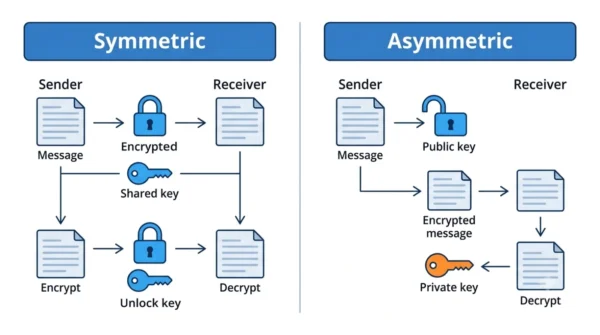
Symmetric encryption uses one shared secret key for both encrypting and decrypting. Asymmetric encryption uses a pair of keys: a public key to encrypt and a private key to decrypt. So the core of symmetric vs asymmetric keys is simple: symmetric is fast but you must share the secret key safely, while asymmetric is slower but solves that key-sharing problem.
In cryptography, the key is what locks and unlocks your data. The big question is whether both sides use the same key or different keys, and that single choice separates symmetric from asymmetric encryption.
This is a core security and GATE topic, often asked as “difference between symmetric and asymmetric key cryptography.” This guide defines each type, lists the algorithms, compares them in a table, and shows how real systems like HTTPS use both together.
If you are revising cryptography, it pairs well with our guide to block cipher vs stream cipher.
What is Symmetric Key Encryption?
Symmetric key encryption uses a single secret key for both encryption and decryption. The sender and receiver must both hold the same key, and anyone with that key can read the data.
It is fast and efficient, which makes it ideal for encrypting large amounts of data. Its weakness is key distribution: you have to get the secret key to the other party without anyone intercepting it. It also scales poorly, needing a separate key for every pair of users.
Common symmetric algorithms are AES, DES, 3DES, and Blowfish. It is used for disk and file encryption, database encryption, and the bulk data inside a VPN or HTTPS session.
What is Asymmetric Key Encryption?
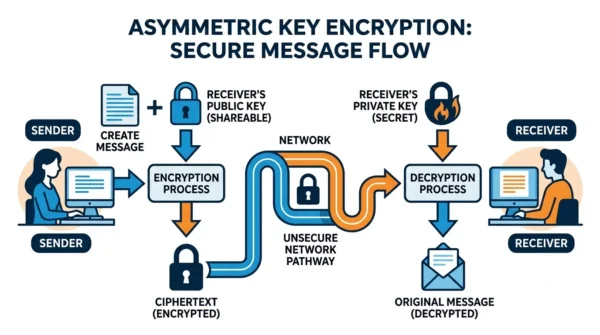
Asymmetric key encryption, also called public-key cryptography, uses a pair of keys: a public key that anyone can have, and a private key that stays secret. Data encrypted with the public key can only be decrypted with the matching private key.
This solves the key-distribution problem, because you can share your public key openly without exposing anything. The same pair also enables digital signatures: signing with the private key lets anyone verify it with the public key. The trade-off is that it is much slower than symmetric encryption.
Common asymmetric algorithms are RSA, ECC (elliptic-curve), Diffie-Hellman, and ElGamal. It is used for key exchange, digital signatures, and the certificates behind HTTPS.
Symmetric vs Asymmetric Keys: Comparison Table
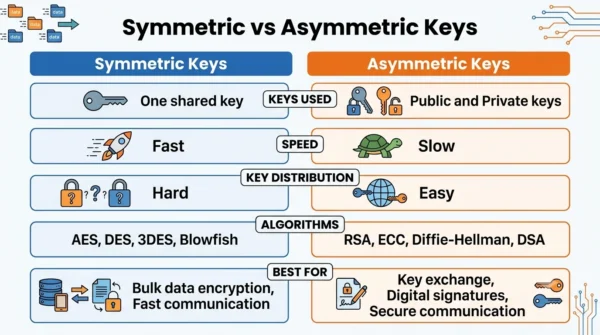
| Aspect | Symmetric Key | Asymmetric Key |
|---|---|---|
| Keys used | One shared secret key | Public + private key pair |
| Encrypt / decrypt | Same key for both | Public encrypts, private decrypts |
| Speed | Fast and efficient | Slow (compute-heavy) |
| Key distribution | Hard — must share the secret safely | Easy — public key is shared openly |
| Keys for n users | n(n-1)/2 | 2n (a pair each) |
| Key length | Shorter (128-256-bit, e.g. AES) | Longer (2048-bit RSA, 256-bit ECC) |
| Digital signatures | No | Yes |
| Provides | Confidentiality only | Confidentiality + authentication |
| Security basis | Secrecy of the shared key | Hard math (factoring, discrete log) |
| Compute / resource use | Low | High |
| Algorithms | AES, DES, 3DES, Blowfish | RSA, ECC, Diffie-Hellman |
| Best for | Bulk data encryption | Key exchange & digital signatures |
How They Work Together in HTTPS
In practice, secure systems use both. This is the key insight that exams and interviews look for. HTTPS, TLS, and most VPNs combine them in a hybrid scheme to get the best of each.
During the TLS handshake, asymmetric encryption is used first to safely exchange a one-time symmetric session key. After that, the much faster symmetric key encrypts the actual data for the rest of the session. So asymmetric solves the key-sharing problem, and symmetric does the heavy lifting.
When to Use Which
Use symmetric encryption when you need to encrypt a lot of data quickly and can share the key securely, such as encrypting files, disks, or databases.
Use asymmetric encryption when two parties have never met and cannot pre-share a secret, or when you need digital signatures and authentication. Its advantage over symmetric is exactly this: open key sharing plus identity verification.
For most real-world communication, you do not choose one — you use a hybrid of both, as HTTPS does.
Interview & Exam Questions
Frequently Asked Questions
Wrapping Up
Symmetric and asymmetric keys solve the same goal in opposite ways. Symmetric uses one shared key that is fast but hard to distribute, while asymmetric uses a public-private pair that is slower but shares safely and signs data.
Remember the pairing: AES for symmetric, RSA for asymmetric, and HTTPS using both together. Choose symmetric for speed on bulk data, asymmetric for key exchange and signatures, and a hybrid for real-world secure communication.
Related reading on DiffStudy: