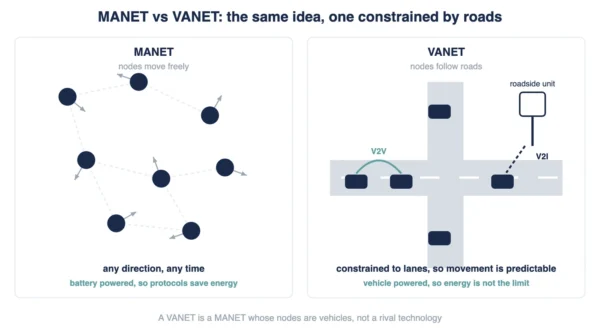
A VANET is not a rival to a MANET. Instead, it is a specialised MANET, one where every node is a vehicle or a roadside unit. A general MANET, by comparison, covers phones, laptops, sensors, and even soldiers on foot. To begin with, movement marks the first real split. A MANET node, in general, moves in a fairly free pattern, modelled as a random walk. A VANET node stays on a road instead, so its path is far more predictable, even though it travels faster. Power, though, is the difference most people miss. A MANET node runs on a battery, so its routing protocol must actively save energy. A VANET node draws power from the vehicle, so energy barely matters there. A VANET also adds a standards stack a plain MANET never needed: IEEE 802.11p, the WAVE architecture, and DSRC in the 5.9 GHz band.
Ad hoc networks show up wherever devices must talk without fixed infrastructure. A mobile ad hoc network, or MANET, is the general case: wireless nodes that organise themselves, with no access point required. In contrast, a VANET, a vehicular ad hoc network, is a specialised MANET. Its nodes just happen to be vehicles and roadside units, rather than phones or laptops. In short, that single fact settles most of the confusion around these two terms.
This guide lines up MANET and VANET side by side. Specifically, it covers how each one moves, powers itself, and organises its topology. It also covers the standards a VANET adds on top of plain ad hoc networking, and why that shift changes routing.
What an Ad Hoc Network Is
An ad hoc network needs no router, no access point, and no fixed backbone. Every node instead cooperates to move traffic along. In fact, a node can originate data, forward someone else’s data, or do both at once. Our guide to cellular network vs ad hoc network covers that contrast against infrastructure-based networks in full.
Two familiar categories sit inside this umbrella. A MANET is the general-purpose case, built from whatever wireless nodes happen to be nearby. By comparison, a VANET narrows that case to one setting: vehicles moving along roads. Accordingly, the rest of this guide treats a VANET as a special case of a MANET, never as a separate category.
What a MANET Is
A MANET’s nodes are ordinary devices: phones, laptops, sensors, and sometimes soldiers carrying radios in the field. Movement, overall, stays fairly free. For instance, researchers usually model it as a random walk or a random waypoint, with no fixed path to follow.
Speed stays low, close to walking pace or a slow vehicle. Likewise, node density stays fairly even across the network, without the sharp swings a road network produces. Topology still changes often, since any node can move, join, or drop out at any time.
Power is the binding constraint. A MANET node runs on a battery, so its routing protocol must actively save energy. Similarly, computing power and storage stay limited, capped by whatever a handset can carry. Position data is often unavailable, since a phone or a sensor might carry no GPS at all.
What a VANET Is
Unlike a MANET, a VANET’s nodes are vehicles and roadside units, not phones or laptops. Movement stays constrained to the road layout, so a vehicle cannot wander off in any direction it likes.
Speed runs much higher, at full road speed. Links between vehicles break faster than in a typical MANET. Node density swings hard. For example, a junction at rush hour gets congested. A rural road at night sits almost empty instead. Topology changes even more often than in a general MANET. Every node moves fast, and the mix of nearby vehicles keeps turning over as a result.
Power is not the binding constraint here. A VANET node draws power straight from the vehicle instead. Energy-efficient routing matters far less than it does for a battery-powered MANET node. A vehicle also carries more computing power and storage than a handset can. GPS is normally present too, so position data is rarely missing.
Three terms describe VANET communication. V2V means vehicle to vehicle. V2I means vehicle to infrastructure, typically a roadside unit. V2X is the umbrella term covering both. In contrast, a plain MANET has no such vocabulary; its nodes just talk node to node.
MANET vs VANET: Comparison Table
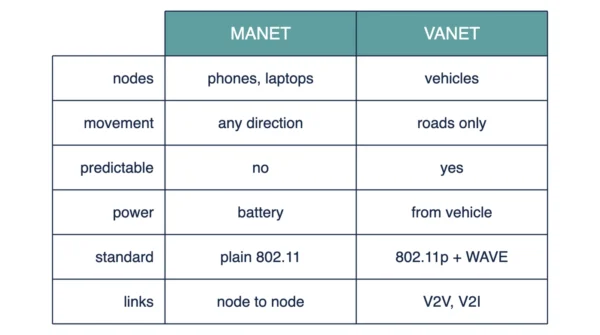
In brief, the table below lines up every verified contrast, side by side.
| Aspect | MANET | VANET |
|---|---|---|
| Relationship | General ad hoc network | Specialised MANET, vehicles only |
| Node type | Phones, laptops, sensors, soldiers | Vehicles, roadside units |
| Mobility pattern | Free, modelled as random walk or waypoint | Constrained to the road layout |
| Predictability | Lower; direction changes freely | Higher, despite the extra speed |
| Speed | Walking pace or slow vehicle | Full road speed |
| Power source | Battery | Drawn from the vehicle |
| Energy constraint | Binding; protocols must save power | Not binding; energy is not scarce |
| Node density | Fairly even | Highly variable, junction to rural road |
| Topology change rate | Frequent | More frequent still |
| Position awareness | Often unavailable | GPS normally present |
| Computing and storage | Limited by the handset | Higher; a vehicle carries more |
| Standard used | Ordinary IEEE 802.11 | IEEE 802.11p plus the WAVE stack |
| Spectrum | No dedicated allocation | 5.9 GHz ITS band, 75 MHz |
| Communication types | Node to node only | V2V, V2I, and V2X |
| Infrastructure | None; purely peer to peer | Roadside units add fixed points |
| Latency sensitivity | No standard broadcast cadence | Safety-critical; BSM every 100 ms, plus jitter |
| Typical applications | Personal, sensor, and military-style devices | Road-safety messaging between vehicles and roadside units |
| Routing style | Proactive or reactive families | Pushed toward position-based, predictive routing |
Mobility: Random Walk versus Roads
A MANET’s mobility model rarely matches real-world constraints. Random walk and random waypoint are both common choices. For instance, both let a node turn in any direction, at any time. As a result, that freedom makes a MANET’s topology hard to predict.
In contrast, a VANET removes most of that freedom. A vehicle follows a road, a lane, and a speed limit, so it cannot suddenly reverse course. That constraint sounds like a disadvantage, yet it is actually useful. A route on a road network is easier to predict than a route through open space. That holds true even though the vehicle itself moves faster.
Speed still carries a real cost, though. A faster node breaks a link sooner, so a VANET’s topology turns over more often than a MANET’s does. Predictability does not cancel that expense. It just gives routing protocols something reliable to plan around. A road layout, or a known direction of travel, works well.
The Standards a VANET Adds
A plain MANET has no dedicated standard. It generally runs over ordinary IEEE 802.11, the same protocol family a laptop uses at home.
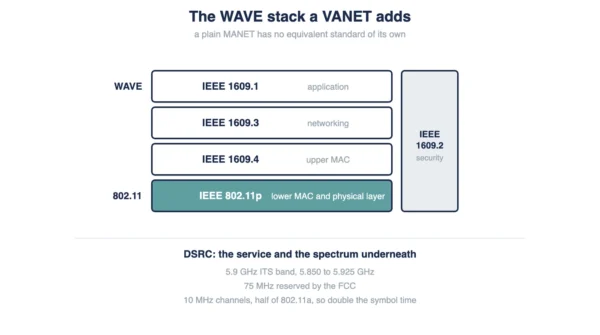
A VANET, however, adds a purpose-built stack on top of that base. IEEE 802.11p is the key amendment. It covers the lower MAC and the physical layer. It is an amendment to 802.11, not a separate standard on its own.
WAVE, or Wireless Access in Vehicular Environments, sits above that amendment. Four more standards fill out the WAVE stack:
- IEEE 1609.1, the application layer
- IEEE 1609.2, security
- IEEE 1609.3, networking
- IEEE 1609.4, the upper MAC
So 802.11p is not the same thing as WAVE; it is one layer inside it.
DSRC, though, is a related but separate idea. DSRC names the service and the spectrum, not the protocol stack above it. It operates in the 5.9 GHz ITS band, from 5.850 to 5.925 GHz. That is a 75 MHz allocation, reserved by the FCC for vehicular use.
802.11p also narrows its channel width. It uses 10 MHz channels, half the 20 MHz that 802.11a uses. That narrower channel doubles the transmission time per symbol, so it tolerates the multipath a moving vehicle causes far better.
The band itself splits into a control channel and several service channels. They then alternate on 50 ms intervals, switching back and forth between safety signalling and everything else.
In particular, safety signalling centres on one message: the Basic Safety Message, or BSM. A vehicle broadcasts a BSM at a nominal 10 Hz, so roughly every 100 ms. Each broadcast also carries a small random jitter, between 0 and 5 ms. Typical DSRC range runs 300 to 500 metres. Clear conditions can stretch that reach to roughly 1,000 metres.
Why Routing Protocols Behave Differently
Ad hoc routing splits into two broad families. Our guide to proactive versus reactive routing protocols covers that split in full. At first, both families were built with a general MANET in mind.
A VANET’s speed changes the calculation. A link breaks sooner, so a route computed even a second too early can expire before any data ever uses it. Guides such as AODV vs DSR and DSDV vs AODV already cover how proactive and reactive designs trade off inside a plain MANET, so this guide will not repeat that ground.
A VANET instead leans toward position-based and predictive routing. A node already knows its own position, since GPS is normally present. A routing decision can then lean on location and direction of travel, instead of a table built from scratch. That shift follows directly from the mobility difference covered earlier.
Where Each One Is Used
A MANET fits any situation where fixed infrastructure is missing, at least for a while. As an illustration, phones, laptops, and sensors group into one, and soldiers on foot carrying radios do the same. What ties these cases together is the node type itself: general-purpose devices, not vehicles.
A VANET fits one setting specifically: vehicles on a road, talking to each other and to roadside units. In particular, that V2V and V2I pattern supports safety messaging directly. The whole point of a Basic Safety Message is simple. One vehicle tells nearby vehicles where it is, ten times a second.
Picking between the two is rarely a real choice. On the whole, a VANET is simply what a MANET becomes once every node turns into a vehicle constrained to a road. The setting decides the category, not the other way round.
Interview Questions
Frequently Asked Questions
Wrapping Up
MANET and VANET are not two competing technologies. Rather, a VANET is what a MANET becomes once every node turns into a vehicle. It moves along roads, instead of wandering freely.
Remember the exam essentials. In contrast, power binds a MANET’s routing choices, and barely touches a VANET’s. A VANET adds a standards stack a plain MANET never needed: 802.11p, WAVE, and DSRC in the 5.9 GHz band. Movement grows more predictable in a VANET, even though it also grows faster. Neither network wins outright; the setting decides which one applies.
Related reading on DiffStudy:
- Proactive vs Reactive Routing Protocols
- AODV vs DSR Routing Protocols
- DSDV vs AODV Routing Protocols
- Cellular Network vs Ad Hoc Network