Inheritance lets one class reuse the fields and methods of another, forming an “is-a” hierarchy (a Car is a Vehicle). Polymorphism lets one interface take many forms, so the same call behaves differently depending on the object’s real type. So inheritance is about structure and reuse, while polymorphism is about flexible behaviour. In fact, the two are partners: runtime polymorphism usually builds on inheritance.
Inheritance and polymorphism are two of the four pillars of object-oriented programming. Both appear across Java, C++, and Python courses, so students need to know what each one does and how they fit together.
They are easy to confuse, because polymorphism often rides on top of inheritance. Yet they answer different questions: inheritance asks “what does this class reuse?”, while polymorphism asks “which version of this method runs?”. This guide defines each, compares them, and shows code.
They sit beside the other OOP pillars, so it also helps to know abstraction vs encapsulation.
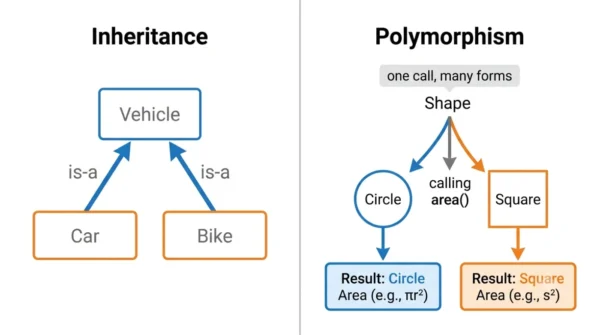
What is Inheritance?
Inheritance lets a class take on the fields and methods of another class. The class being inherited from is the base class (or superclass), and the class that inherits is the derived class (or subclass). So it models an “is-a” relationship and promotes code reuse.
For example, a Vehicle class holds shared attributes like speed and colour, and a Car subclass inherits those while adding its own:
class Vehicle:
    def __init__(self, speed, color):
        self.speed = speed
        self.color = color

class Car(Vehicle):
    def __init__(self, speed, color, model):
        super().__init__(speed, color)   # reuse the parent's setup
        self.model = model
Advantages:
- Code reuse, since a subclass inherits the parent’s members.
- Modularity, because related classes form a clear hierarchy.
- It enables runtime polymorphism through overriding.
Disadvantages:
- Tight coupling, so a change in the parent can ripple to subclasses.
- Deep hierarchies grow complex and hard to maintain.
What is Polymorphism?
Polymorphism means “many forms”. It lets objects of different classes respond to the same call in their own way, usually through a common type. So one interface can drive many behaviours.
It comes in two forms. Compile-time polymorphism uses method overloading, while runtime polymorphism uses method overriding with dynamic dispatch. For example, every Shape defines area(), and each subclass overrides it:
class Shape:
    def area(self):
        return 0

class Circle(Shape):
    def __init__(self, radius):
        self.radius = radius
    def area(self):
        return 3.14 * self.radius * self.radius

class Square(Shape):
    def __init__(self, side):
        self.side = side
    def area(self):
        return self.side * self.side

for shape in [Circle(2), Square(3)]:
    print(shape.area())   # same call, different result per type
Advantages:
- Flexibility, since behaviour depends on the real object at runtime.
- Extensibility, because new subclasses slot in without changing callers.
Disadvantages:
- Dynamic dispatch adds a small runtime overhead.
- Tracing polymorphic behaviour in a big codebase can be tricky.
Inheritance vs Polymorphism: Comparison Table
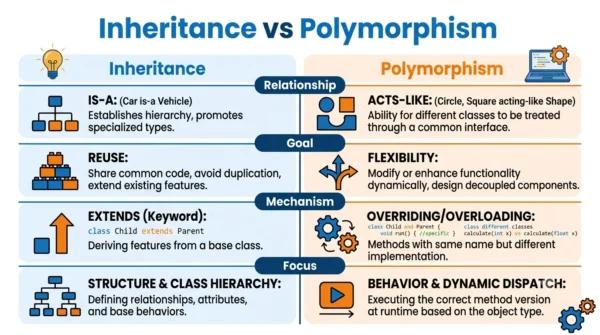
| Aspect | Inheritance | Polymorphism |
|---|---|---|
| Definition | A class reuses another class’s members | One interface, many behaviours by type |
| Relationship | “is-a” (a Car is a Vehicle) | “acts-like” (treat as the common type) |
| Main goal | Code reuse and hierarchy | Flexibility and interchangeability |
| Needs a hierarchy? | Yes, parent and child | Often, via inheritance or interfaces |
| Mechanism | extends (Java), : (Python) | Method overriding and overloading |
| Forms | One mechanism | Compile-time (overloading) and runtime (overriding) |
| Binding | Set by the class hierarchy | Runtime form uses dynamic (late) binding |
| Focus | Structure and classification | Behaviour and interaction |
| Coupling | Can create tight coupling | Decouples caller from concrete type |
| Depends on | Stands on its own | Runtime form usually relies on inheritance |
| Example | Car inherits from Vehicle | shape.area() runs Circle’s or Square’s version |
| Used for | Building class hierarchies | Generic, extensible code |
How They Work Together
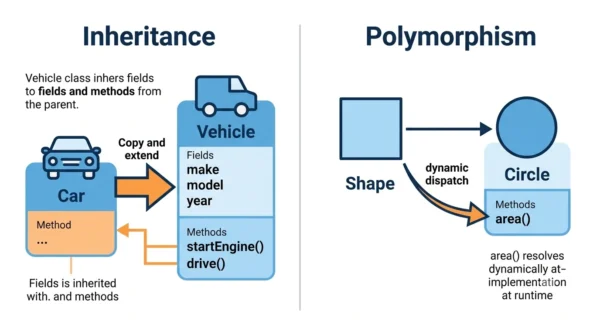
These two ideas are not rivals; they are partners. Inheritance builds the class tree and lets a subclass override a parent method. Then runtime polymorphism uses that override, so a base-type reference calls the correct subclass version.
This Java example shows both at once. Dog inherits from Animal and overrides sound(), then a parent reference dispatches to the child:
class Animal {
    void sound() { System.out.println("Animal makes a sound"); }
}

class Dog extends Animal {       // inheritance
    @Override
    void sound() { System.out.println("Dog barks"); }
}

Animal a = new Dog();   // polymorphism: parent type, child object
a.sound();              // prints "Dog barks" (dynamic dispatch)
So inheritance supplies the structure, and polymorphism supplies the flexible behaviour on top of it.
When to Use Inheritance or Polymorphism
Reach for inheritance when classes share a clear “is-a” relationship and you want to reuse code. However, prefer composition over deep inheritance chains, since those grow brittle.
Reach for polymorphism when you want one piece of code to handle many types uniformly. For example, a method that loops over a list of Shape objects and calls area() works for any current or future shape.
In practice, you use both together. So you design a sensible hierarchy with inheritance, then lean on polymorphism, often via interfaces, to keep the code flexible and extensible.
Frequently Asked Questions
Wrapping Up
Inheritance and polymorphism are core OOP pillars, yet they solve different problems. Inheritance reuses code through an “is-a” hierarchy, while polymorphism lets one call take many forms based on the object’s type.
So remember that they work together: inheritance gives the structure, and polymorphism gives the flexible behaviour on top. With a clean hierarchy and good use of overriding or interfaces, you get code that is both reusable and extensible.
Related reading on DiffStudy: