
Pure ALOHA lets a device transmit a frame at any moment, so a collision can happen across a 2T window, which caps its efficiency near 18.4%. Slotted ALOHA forces every frame to start at a time-slot boundary, so the vulnerable window shrinks to T, which doubles the peak efficiency to about 36.8%. In short, slotting time halves collisions and doubles throughput.
Pure ALOHA and slotted ALOHA are two early random-access protocols for sharing one wireless channel. They are a staple of computer-networks and GATE syllabi, so students need to know exactly why slotting time makes such a big difference.
Both let devices transmit without first sensing the channel, so collisions are the central problem. This guide defines each protocol, explains the vulnerable period and efficiency, compares them in a table, and shows when to use which.
They are multiple-access schemes, so it also helps to know TDMA vs CDMA.
What is Pure ALOHA?
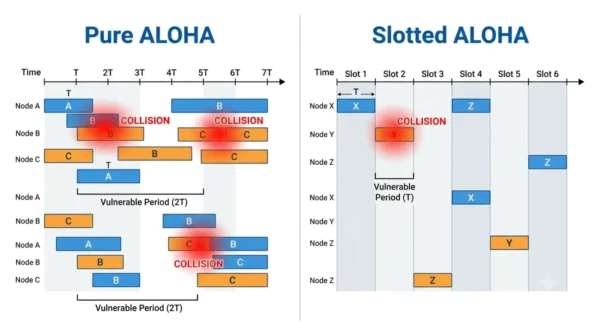
Pure ALOHA is an early contention-based protocol, developed at the University of Hawaii in the 1970s. It works on a simple rule: a device transmits a frame whenever it has data, with no coordination. So if two frames overlap at all, they collide, and each sender waits a random time before trying again.
Advantages:
- Immediate transmission, since a device sends as soon as it is ready.
- Very simple to implement, with minimal overhead.
- No need for clock synchronisation between devices.
Limitations:
- Frequent collisions, because senders never coordinate.
- No contention or priority management, so it congests under load.
- Low efficiency, capped near 18.4%.
What is Slotted ALOHA?
Slotted ALOHA improves on Pure ALOHA by dividing time into equal slots, each the length of one frame. A device may start a transmission only at the beginning of a slot. So two frames either share a slot completely or not at all, which removes the partial overlaps that plague Pure ALOHA.
Benefits:
- Fewer collisions, thanks to the slot boundaries.
- Higher throughput, roughly double that of Pure ALOHA.
- Supports acknowledgements, so lost frames can be retransmitted.
Drawbacks:
- Needs clock synchronisation across all devices.
- Slot timing adds some overhead.
- Harder to implement than Pure ALOHA.
Vulnerable Period and Efficiency
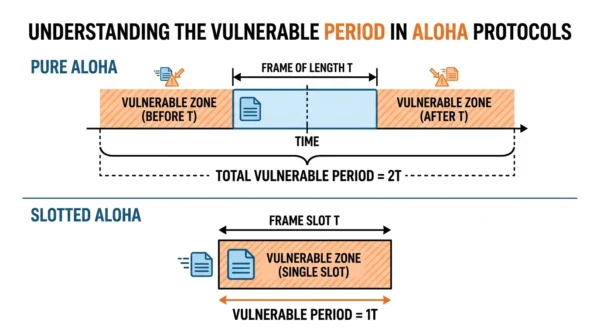
The key idea is the vulnerable period: the time window in which another frame can cause a collision. In Pure ALOHA, a frame of length T collides with any frame that starts up to one T before or after it, so the window is 2T. In slotted ALOHA, frames only start at slot boundaries, so the window shrinks to a single T.
That halved window directly doubles the throughput. If G is the offered load, Pure ALOHA throughput is S = G·e−2G, which peaks at G = 0.5 with a maximum of 1/2e ≈ 18.4%. Slotted ALOHA throughput is S = G·e−G, which peaks at G = 1 with a maximum of 1/e ≈ 36.8%. So slotting time exactly doubles the best-case efficiency.
Pure ALOHA vs Slotted ALOHA: Comparison Table
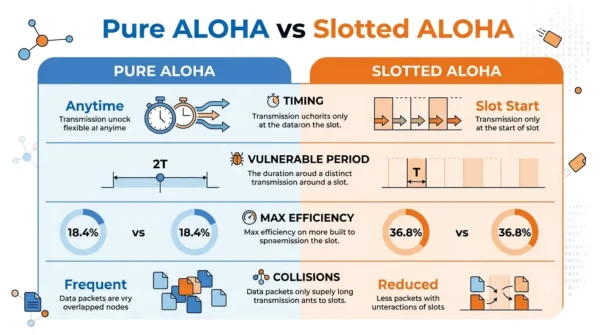
| Aspect | Pure ALOHA | Slotted ALOHA |
|---|---|---|
| Transmission timing | At any time | Only at the start of a slot |
| Time structure | Continuous (no slots) | Divided into equal slots |
| Vulnerable period | 2T (two frame times) | T (one frame time) |
| Throughput formula | S = G·e−2G | S = G·e−G |
| Max efficiency | About 18.4% (1/2e) at G = 0.5 | About 36.8% (1/e) at G = 1 |
| Collisions | Frequent | Fewer |
| Throughput | Lower | Higher (about double) |
| Clock sync | Not needed | Required |
| Overhead | Minimal | Slot timing overhead |
| Implementation | Simple | More complex |
| Latency | Immediate transmission | Waits for the next slot |
| Error recovery | None built in | Acknowledgements possible |
| Best for | Simple, low-traffic networks | Busier, synchronised networks |
When to Use Pure or Slotted ALOHA
Choose Pure ALOHA when simplicity matters more than efficiency and traffic is light. For example, early wireless links and simple sensor systems use it, because it needs no clock synchronisation.
Choose slotted ALOHA when you need better efficiency and the devices can keep a shared clock. For instance, satellite and some cellular systems use it, since the doubled throughput is worth the timing overhead.
In practice, both are mostly historical now. Modern networks build on carrier-sense protocols like CSMA/CD and CSMA/CA, which listen before they transmit. Even so, ALOHA remains the classic starting point for understanding random access.
Frequently Asked Questions
Wrapping Up
Pure ALOHA and slotted ALOHA are the foundational random-access protocols, and a single idea separates them: the vulnerable period. Pure ALOHA allows transmission any time, giving a 2T window and about 18.4% efficiency, while slotted ALOHA aligns frames to slots, cutting the window to T and reaching about 36.8%.
So remember the rule: slotting time halves collisions and doubles throughput. Though carrier-sense protocols have largely replaced both, ALOHA stays the clearest way to learn how shared channels and collisions work.
Related reading on DiffStudy:
It is very easy to understand and simple. Its very useful.
Great Post! Thanks for Sharing!