TDMA (Time Division Multiple Access) lets several users share one frequency band, yet each one transmits only in its own assigned time slot, so the system needs tight time synchronization. CDMA (Code Division Multiple Access) lets every user transmit at the same time on the same frequency, because a unique spreading code separates each signal. In short, TDMA divides the channel by time, while CDMA divides it by code.
TDMA and CDMA are two ways to let many users share one wireless channel. Both appear in every computer networks and GATE syllabus. Students often blur how each one separates users and which mobile systems use which method.
The core question is simple. Should users take turns in time, or should they all talk at once under different codes? TDMA takes the first path, while CDMA takes the second. This guide defines each method, compares them in detail, and shows where each one is used.
If you are still mapping out the basics, it helps to compare Pure ALOHA and Slotted ALOHA first, since they also share one channel among many users.
What is TDMA?
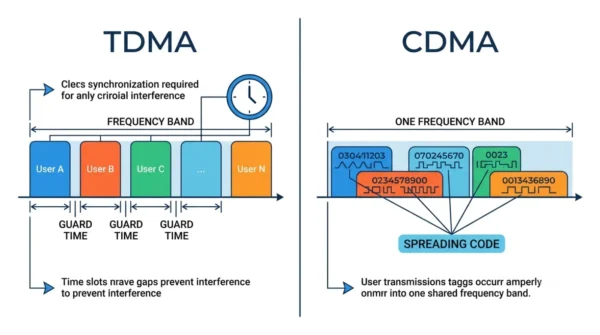
TDMA stands for Time Division Multiple Access. It lets multiple users share the same frequency channel by splitting time into distinct slots. So each user gets a specific time slot, and they transmit and receive only inside that allotted window.
Because users take turns on one frequency, the network must keep clocks aligned. As a result, TDMA needs tight time synchronization, plus small guard times between slots to stop one user’s burst from spilling into the next. One neat side effect helps battery life: the transmitter switches off between slots, so the handset saves power. The classic example is 2G GSM, which delivers digital wireless service using time-division multiplexing.
Advantages of TDMA:
- Optimized resource utilisation, since dividing one channel into slots packs many calls onto each frequency.
- Enhanced call quality, because dedicated slots keep users from talking over each other.
- Lower handset power, as the transmitter rests between its slots.
- A simpler design with no near-far problem, because users never transmit at the same instant.
Disadvantages of TDMA:
- Strict timing, so the whole network must stay synchronized to the slot boundaries.
- Wasted capacity, because guard times and idle slots are not free.
- A hard slot limit, since a frame holds only a fixed number of slots.
What is CDMA?
CDMA stands for Code Division Multiple Access. It assigns a unique code to each user, so many users can share the same frequency channel at the same time. Each user’s data rides on a different spreading code, and the receiver uses that code to decode only the signal meant for it.
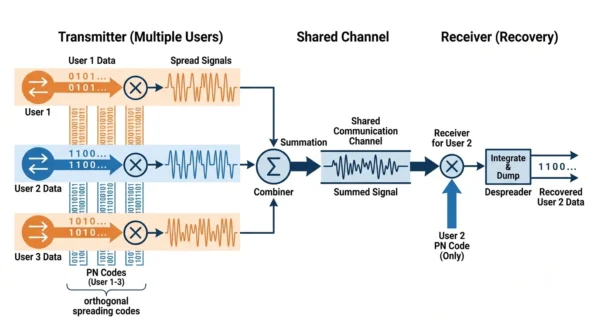
This is a spread-spectrum technique, so each narrow signal is spread across a wide band using a pseudo-random (PN) code. Because the codes are nearly orthogonal, the signals overlap without scrambling each other. However, a strong nearby phone can drown out a distant one, the so-called near-far problem, so CDMA relies on careful power control to keep every signal at a similar level. The classic examples are IS-95 and the 3G systems CDMA2000 and WCDMA.
Advantages of CDMA:
- Increased capacity, since many users transmit at once on the same frequency under different codes.
- Improved resistance to interference and multipath fading, thanks to the spreading codes.
- Soft capacity with no hard slot limit, so the cell degrades gracefully as load rises.
- Inherent privacy, because a listener without the code cannot pull the signal out.
Disadvantages of CDMA:
- The near-far problem, which forces strict, fast power control on every handset.
- More complex receivers, since decoding a spread signal takes extra processing.
- Capacity that falls as interference rises, because all users share one band.
TDMA vs CDMA: Comparison Table
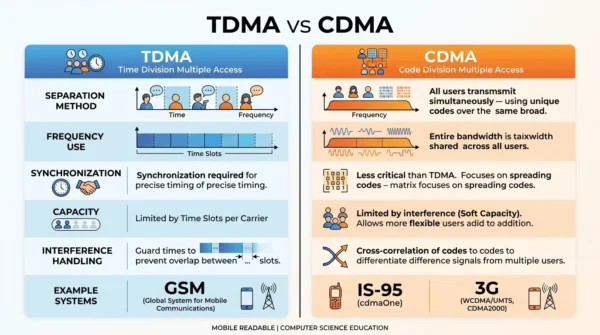
| Aspect | TDMA | CDMA |
|---|---|---|
| Full form | Time Division Multiple Access | Code Division Multiple Access |
| Core technique | Digital wireless service using time-division multiplexing (TDM) | Digital cellular technology using spread-spectrum techniques |
| How users are separated | By assigned time slot | By unique spreading code |
| Frequency use | One frequency, split into time slots | One frequency, shared at the same time |
| Channel sharing | Time-sharing of the satellite transponder (or channel) | Sharing of both bandwidth and time together |
| Simultaneous use | Terminals are active for short periods on the same frequency | All terminals can be active at the same place and moment, uninterrupted |
| Frequency per user | Divides a radio frequency into time slots and allocates them to calls | Does not assign a specific frequency to each user |
| Synchronization | Necessary (tight slot timing) | Not required in the same way |
| Guard interval | Guard time between slots | No time-slot guards needed |
| Capacity | Hard limit set by the number of slots | Higher, soft capacity that degrades gradually |
| Interference handling | Avoids it by giving each user a dedicated slot | Tolerates it using coding and spreading |
| Key challenge | Keeping the network time-synchronized | Solving the near-far problem with power control |
| Handset power | Lower, since the transmitter rests between slots | Higher, due to continuous transmission and processing |
| Privacy | Lower, as slots are easy to follow | Higher, since the code is needed to decode |
| Receiver complexity | Simpler | More complex |
| Example systems | 2G GSM, D-AMPS (IS-136) | IS-95, CDMA2000, WCDMA (3G) |
How TDMA and CDMA Separate Users
The clearest way to see the gap is to picture three callers, Asha, Bilal, and Chitra, sharing one frequency.
On a TDMA channel, the frequency is split into a repeating frame of time slots. So Asha speaks in slot 1, Bilal in slot 2, and Chitra in slot 3, then the frame repeats. Each one transmits in short bursts, and a guard time keeps the bursts from colliding. Because they never overlap in time, the design stays simple, yet the slot count caps how many callers fit.
On a CDMA channel, all three speak at once over the same frequency. Each phone multiplies its data by a different spreading code, so the three signals add together on the air. The receiver then multiplies by Chitra’s code, which cancels Asha and Bilal and leaves Chitra’s signal clear. As a result, capacity is not fixed by slots, though every extra user adds a little background noise for the rest.
It also helps to contrast both with FDMA. Frequency Division Multiple Access hands each user a separate frequency band for the whole call, so users are split by frequency rather than by time or code. In short, FDMA divides by frequency, TDMA divides by time, and CDMA divides by code.
Real Systems That Use TDMA and CDMA
Both methods shaped the mobile networks that students grew up with.
- TDMA systems: 2G GSM is the headline example, and it still carries calls in many regions. D-AMPS (IS-136) was another TDMA standard.
- CDMA systems: IS-95 (cdmaOne) introduced CDMA to cellular, and the 3G families CDMA2000 and WCDMA built on it.
- Modern note: 4G LTE and 5G moved on to OFDMA and SC-FDMA, yet the spreading and code ideas from CDMA still echo in their design.
So if you used a 2G phone, you most likely used TDMA. If you used an early CDMA carrier or 3G data, you used CDMA instead.
When to Use TDMA or CDMA
You rarely pick the access method yourself, yet the trade-off explains the real designs.
Choose a TDMA-style scheme when simplicity, low handset power, and predictable slots matter. Because each user owns a clean slot, the receiver stays simple and the phone saves battery between bursts. That fit made TDMA the backbone of 2G voice.
Choose a CDMA-style scheme when capacity and robustness lead. Since all users share the band under codes, the cell flexes with demand and resists interference and fading well. So in practice the system goals, not personal taste, decide which method a network adopts.
Interview Questions
Frequently Asked Questions
Wrapping Up
TDMA and CDMA solve the same problem from opposite directions. TDMA efficiently splits one frequency into time slots, which optimises resource use and keeps call quality clean. CDMA instead uses unique codes for simultaneous communication, which raises capacity and resists interference.
Remember the simple rule: TDMA separates users by time, while CDMA separates them by code. So whether you prefer the time-based efficiency of TDMA or the code-based capacity of CDMA, both shaped modern wireless networks. Knowing that trade-off is enough to answer most exam and interview questions on the two.
Related reading on DiffStudy: