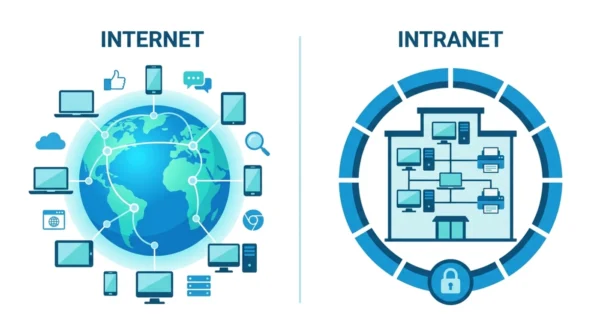
The internet is a public, global network that anyone can join. An intranet is a private network that works only inside one organisation. Both use the same TCP/IP protocols, but an intranet stays behind a firewall for authorised users. So the internet favours open reach, while an intranet favours secure internal control.
Students often mix up these two terms because they sound alike and share the same technology. However, the internet vs intranet comparison really comes down to who can connect and how widely the network reaches. One is open to the whole planet, and the other is locked to a single company or campus.
In this guide, we break down access, security, scope, cost, and real examples. We also explain the extranet, a useful middle ground that exam questions love to ask about. By the end, you can answer any comparison question with confidence.
This topic appears across GATE, university networking papers, and technical interviews. Therefore, a clear mental model helps you score quick marks and avoid silly mistakes.
What Is the Internet?
The internet is the global system of interconnected computer networks. It links billions of devices across countries using the TCP/IP protocol suite. Anyone with a connection can reach it, so it is truly public and open.
It carries the World Wide Web, email, video calls, and countless other services. No single owner controls it, although standards bodies and providers keep it running. Because it is so vast, security depends on each user and site.
What Is an Intranet?
An intranet is a private network that serves a single organisation. It often consists of many interlinked LANs inside one company or campus. Only authorised members, such as employees, can sign in and use it.
An intranet uses the same web technologies as the internet, including TCP/IP, HTTP, and browsers. Companies run it for internal portals, document sharing, HR tools, and team collaboration. A firewall keeps outsiders away, which makes the intranet far more secure.
What About the Extranet?
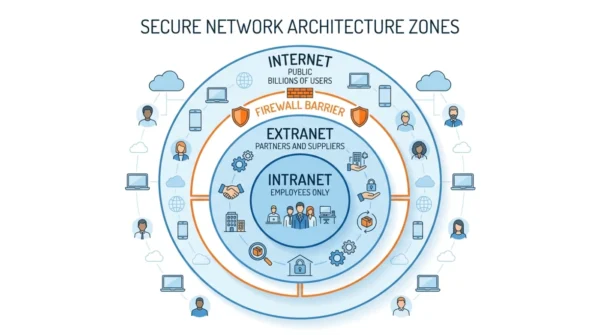
An extranet is a controlled extension of an intranet to trusted outsiders. It lets partners, suppliers, or clients reach selected internal resources. Think of it as a guarded bridge between the private intranet and the public internet.
For example, a company may give a supplier a login to track orders. That supplier sees only the shared area, not the full intranet. So the extranet balances limited outside access with strong internal security.
Key Differences: Internet vs Intranet
The table below sums up the main contrasts. Use it as a quick revision sheet before an exam or interview.
| Aspect | Internet | Intranet |
|---|---|---|
| Definition | Global system of interconnected networks | Private network within one organisation |
| Type | Open, public network | Closed, private network |
| Access | Open to anyone with a connection | Limited to authorised members |
| Scope and size | Worldwide, billions of users | Local to a company or campus |
| Ownership | No single owner | Owned by one organisation |
| Security | Less safe; needs extra protection | More secure; sits behind a firewall |
| Protocols | TCP/IP, HTTP, and many others | Same TCP/IP and web protocols |
| Content | Public and largely unrestricted | Internal and organisation specific |
| Cost | Subscription to an ISP for access | Setup and upkeep paid by the organisation |
| Number of users | Unlimited, global audience | Limited to staff and approved users |
| Relationship | The larger parent network | Can be seen as a private slice of internet tech |
| Examples | Google, YouTube, public email, online banking | Company HR portal, internal wiki, staff directory |
Access, Security, and Scope
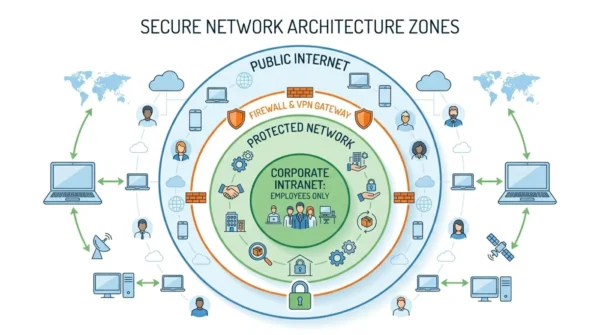
Access is the clearest divide. The internet welcomes everyone, while an intranet checks identity before granting entry. As a result, an intranet keeps sensitive company data away from the public.
Security follows from access. An intranet relies on firewalls, logins, and internal controls, so threats stay low. By contrast, the open internet exposes users to many risks, which is why sites add encryption such as SSL and TLS.
Scope and cost differ too. The internet spans the globe, and users simply pay an ISP to connect. An intranet covers one organisation, and that organisation funds its setup and maintenance. When an intranet must reach remote staff safely, teams often use a VPN or proxy over the public internet.
When to Use Which
Choose the internet when you need worldwide reach. Public websites, customer apps, and online services all belong here. Anyone, anywhere, should be able to find and use them.
Choose an intranet when information must stay inside the organisation. Internal policies, payroll data, and team wikis fit this case well. The private boundary protects data and keeps daily work organised.
Pick an extranet for the middle ground. When trusted partners need limited access, share a guarded slice rather than the whole intranet. In short, match the network to the audience you actually want.
Interview Questions
Frequently Asked Questions
Wrapping Up
The internet vs intranet question comes down to reach versus control. The internet connects the whole world, while an intranet protects one organisation. An extranet then bridges the two for trusted partners.
Remember the same protocols power both networks. Once you focus on access, scope, and security, every comparison answer falls into place.
Related reading on DiffStudy:
- CS Fundamentals
- IPv4 vs IPv6
- OSI Model vs TCP/IP Model
- TCP vs UDP
- MAC Address vs IP Address
- VPN vs Proxy Servers
- SSL vs TLS
- Web 1.0 vs Web 2.0 vs Web 3.0