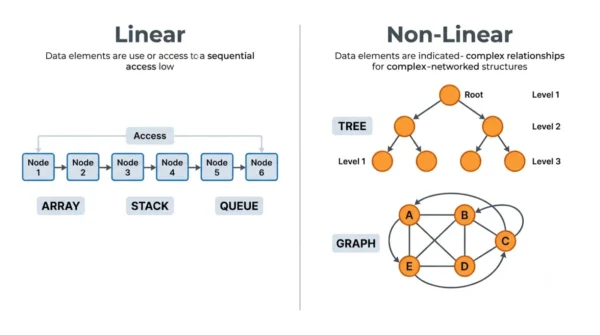
A linear data structure arranges elements in a single sequence, one after another, on a single level. Think of an array or linked list. A non-linear data structure arranges elements in a hierarchy or network, across multiple levels (like a tree or graph). So linear vs non-linear data structures comes down to one idea: are the elements in a straight line, or branching out?
Data structures organise how we store and access data, and they fall into two broad families: linear and non-linear. The split is one of the first things you learn in DSA. It is also a staple of networking and GATE exams.
The difference is about arrangement. In a linear structure, elements follow one after another. In a non-linear structure, an element can connect to many others, forming a hierarchy or network. This guide defines each, gives examples, and compares them.
For how these choices affect speed, see our guide to the time complexity of data structures.
What is a Linear Data Structure?
A linear data structure stores elements in a sequence. Each element is connected to the one before it and the one after it. All elements sit on a single level, arranged one after another.
Because the data is in a straight line, you can traverse it in a single run. You visit each element one by one. This makes linear structures simple to understand and implement.
The common examples are the array, linked list, stack, and queue. The trade-off is that memory use can be less efficient, and operations like search can be slow as the data grows.
What is a Non-Linear Data Structure?
A non-linear data structure stores elements in a hierarchy or network, not a single sequence. An element can connect to many others, and the data spreads across multiple levels.
Because the elements branch out, you cannot traverse them in a single run. You need recursion or multiple passes to visit every element. This makes non-linear structures more complex, but also more powerful for modelling real relationships.
The common examples are the tree, graph, and heap. They use memory efficiently and represent hierarchical or connected data, like a file system or a social network.
Linear vs Non-Linear Data Structures: Comparison Table
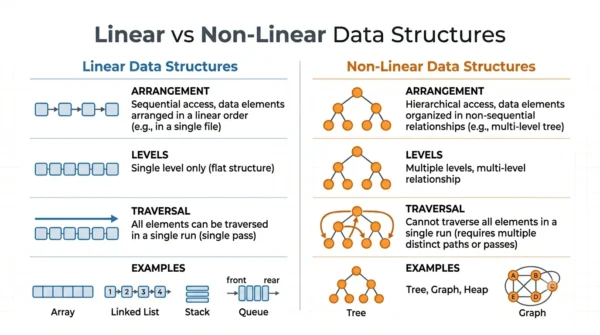
| Aspect | Linear | Non-Linear |
|---|---|---|
| Arrangement | Sequential, one after another | Hierarchical or networked |
| Levels | Single level | Multiple levels |
| Element relationship | One-to-one (one predecessor, one successor) | One-to-many or many-to-many |
| Traversal | Single run (one pass) | Multiple runs (recursion needed) |
| Traversal method | Simple loop | DFS, BFS, or recursion |
| Implementation | Simpler | More complex |
| Memory utilization | Less efficient | More efficient |
| Time complexity as data grows | Tends to rise (e.g., O(n) search) | Can stay efficient (e.g., O(log n) in a BST) |
| Relationship modelled | Simple sequences | Hierarchies and networks |
| Applications | Scheduling, undo, buffering | File systems, networks, databases, AI |
| Growth direction | One direction | Multiple directions (branches) |
| Examples | Array, Linked List, Stack, Queue | Tree, Graph, Heap |
Examples of Each
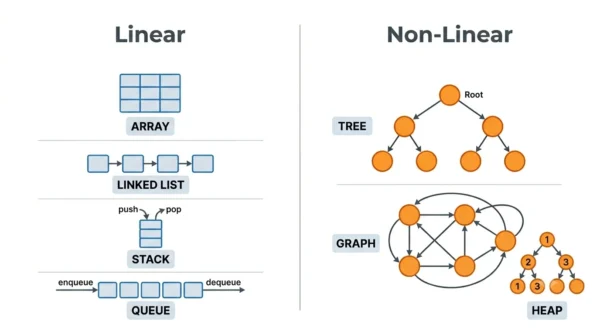
Examples make the two families clear.
- Linear: an array and linked list store items in order, while a stack and queue add and remove items in a fixed sequence.
- Non-linear: a tree and graph link nodes across branches and networks, while a heap is a tree-based structure used for priority ordering.
Is It Linear or Non-Linear?
A few cases trip students up, so here is the quick answer for each.
- Linked list: linear. Even though it uses pointers, the elements still form a single sequence.
- Stack and queue: linear. Items are added and removed in order.
- Tree: non-linear. Nodes branch into a hierarchy with parent and child levels.
- Graph: non-linear. Nodes connect to many others, forming a network.
Interview & Exam Questions
Frequently Asked Questions
Wrapping Up
The whole comparison rests on arrangement. Linear data structures place elements in one sequence on a single level. Non-linear data structures branch them across a hierarchy or network.
Remember the examples: array, linked list, stack, and queue are linear; tree, graph, and heap are non-linear. Reach for linear when order and simplicity matter, and non-linear when you need to model hierarchy or connections.
Related reading on DiffStudy: