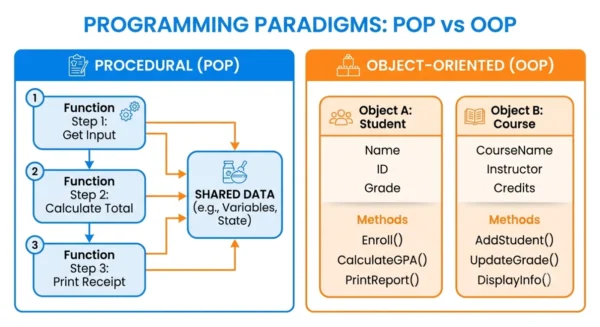
Procedural programming (POP) breaks a program into functions that run in sequence and act on shared data. It follows a top-down approach, as in C, Pascal, and FORTRAN. Object-oriented programming (OOP) models the program as objects, where each object bundles its own data and the methods that use it. It follows a bottom-up approach, as in C++, Java, and Python. In short: POP organises code around the steps to perform, while OOP organises it around the objects that exist, adding data hiding, inheritance, and polymorphism for safer, reusable, large-scale software.
Procedural vs object-oriented programming is one of the first paradigm choices every CS student meets, and it appears in nearly every GATE paper and coding interview. The same comparison is often written as OOP vs POP, where POP stands for Procedural-Oriented Programming. Both names point to the same question: should code be built from functions or from objects?
The two paradigms solve the same problems in different ways. Procedural code lists the steps to perform and runs them on data that functions share. Object-oriented code wraps that data inside objects and attaches the behaviour to it. That one shift, from “steps first” to “objects first,” changes how each style handles security, reuse, and scale.
This guide defines both paradigms, walks through the four pillars of OOP, compares them point by point, and shows the same task written in C and in Python. By the end you will know which one fits a given project and why interviewers keep asking about it.
What is Procedural Programming (POP)?
Procedural programming, often shortened to POP (Procedural-Oriented Programming), builds a program from a set of functions, also called procedures. Each function performs a task, and the functions run in sequence. The data they work on is usually shared, often held in global variables that any function can read or change.
POP uses a top-down design. You start with the main task, then break it into smaller functions until each piece is simple enough to code. The focus stays on the actions to perform rather than on the data itself.
Key traits of procedural programming:
- Functions are the basic building block, and they operate on data passed to them or stored globally.
- Execution flows top to bottom in a mostly linear order.
- Data and functions stay separate, so there is no built-in data hiding.
- It is simple and fast to debug for small programs, but harder to maintain as the code grows.
C, Pascal, and FORTRAN are classic procedural languages. POP suits system programming, scripting, and computation-heavy tasks where the logic matters more than modelling real-world entities.
What is Object-Oriented Programming (OOP)?
Object-oriented programming (OOP) builds a program from objects. An object bundles together its own data, called attributes, and the methods that act on that data. A class is the blueprint, and an object is an instance created from it.
OOP uses a bottom-up design. You first model the objects in the problem, then build the program by letting those objects interact. Because data lives inside objects, OOP can hide it and expose only safe ways to change it.
This design makes data the centre of the program. Behaviour travels with the data it belongs to, so a change inside one class rarely breaks the rest of the code. That locality is why OOP scales to large, evolving software. C++, Java, Python, and C# are common object-oriented languages.
The Four Pillars of OOP
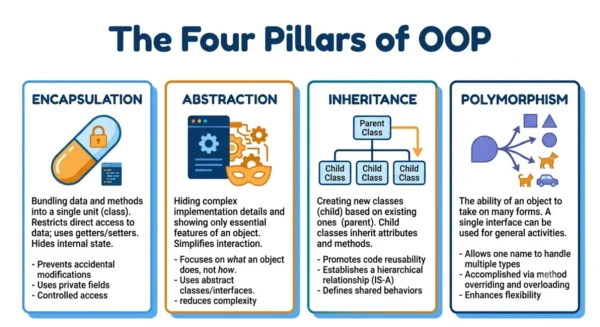
Four principles separate OOP from procedural code. Interviewers ask about them constantly, and a handy way to recall them is the acronym A-PIE.
Encapsulation
Bundles data with the methods that act on it, and hides the internal data behind access specifiers. Code changes the data only through controlled methods. See abstraction vs encapsulation.
Abstraction
Exposes only the essential features and hides the implementation. You work with the “what,” not the “how” — often through abstract classes and interfaces.
Inheritance
Lets a child class reuse and extend a parent class, an “is-a” relationship that cuts duplication. It pairs closely with polymorphism — see inheritance vs polymorphism.
Polymorphism
Lets one name take many forms, through overloading and overriding. The two flavours split into compile-time and run-time polymorphism.
Procedural programming has none of these built in. That absence is the root of most differences below.
OOP vs POP: Key Differences
| Aspect | Procedural (POP) | Object-Oriented (OOP) |
|---|---|---|
| Design approach | Top-down: split the main task into functions | Bottom-up: design objects, then make them interact |
| Basic unit | The function (procedure) | The object (an instance of a class) |
| Focus | Functions and the sequence of actions | Data and the objects that own it |
| Data security | Data is mostly global and open, so less secure | Access specifiers (private, protected, public) protect data |
| Data hiding | None; data and functions are separate | Encapsulation bundles and hides data |
| Reusability | No inheritance; reuse means calling or copying functions | Inheritance reuses and extends existing classes |
| Modularity | Through separate functions and modules | Through self-contained classes and objects |
| Polymorphism | Generally none; one function does one job | Overloading (compile-time) and overriding (run-time) |
| Maintenance | A data change can ripple across many functions | Changes stay localised inside a class |
| Best for | Small to medium, logic-driven programs and scripts | Large, complex, evolving software |
| Example languages | C, Pascal, FORTRAN, COBOL | C++, Java, Python, C#, Ruby |
| Analogy | A cooking recipe: steps performed in order | A car: one object with its own data and actions |
Code Examples (C vs Python)
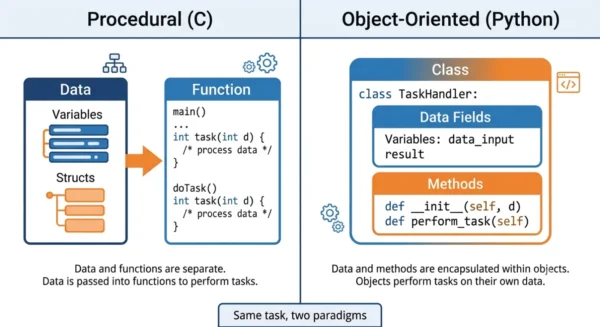
The clearest way to see the difference is the same task in both styles. Both snippets calculate a rectangle’s area.
Procedural (C): the function and the data are separate.
#include <stdio.h>

/* Data and the function that uses it are SEPARATE.
   The data is passed in as arguments. */
float calculate_area(float length, float width) {
    return length * width;
}

int main() {
    float length = 5.0f;
    float width  = 10.0f;
    float area = calculate_area(length, width);
    printf("Area: %.1f\n", area);   /* Area: 50.0 */
    return 0;
}
Here the data lives in main() and the standalone function acts on it. Data and behaviour stay apart, which is the defining trait of POP.
Object-oriented (Python): the data and the method live together.
class Rectangle:
    def __init__(self, length, width):
        # Data (attributes) belong to the object
        self.length = length
        self.width = width

    def calculate_area(self):
        # Behaviour lives WITH the data it uses
        return self.length * self.width

rectangle = Rectangle(5, 10)
print("Area:", rectangle.calculate_area())   # Area: 50
Now the Rectangle class bundles the data and the method together. The object owns and operates on its own data, which is encapsulation in action. The task is identical; only the paradigm changes. If you also weigh the language choice, see our guide to Java vs Python, and for how data is grouped in C, see structure vs class.
When to Use Procedural vs Object-Oriented Programming
Choose procedural programming for small or medium programs where the logic is the star. Scripts, system utilities, embedded code, and computation-heavy tasks all fit POP well. It stays simple, runs fast, and is easy to follow when the program is short.
Choose object-oriented programming for large, evolving software with many interacting entities. GUI apps, games, and enterprise systems benefit from encapsulation, inheritance, and polymorphism. These features keep a big codebase organised, secure, and easy to extend.
In practice, many programs are hybrid. A language like Python supports both, so teams use plain functions for quick jobs and classes for larger structures. The goal is to match the paradigm to the problem, not to follow one style everywhere.
Interview Questions on OOP vs POP
Frequently Asked Questions
Wrapping Up
The whole comparison comes down to one shift. Procedural programming organises code around the steps to perform, while object-oriented programming organises it around the objects that exist. POP keeps data and functions apart; OOP bundles them and guards the data with encapsulation, inheritance, and polymorphism.
So when you start a project, ask how big and how long-lived it is. A short, logic-driven script leans procedural. A large system with many entities leans object-oriented. Match the paradigm to the problem, and the choice between OOP and POP becomes simple.
Related reading on DiffStudy:
- Abstraction vs Encapsulation and Inheritance vs Polymorphism
- Method Overloading vs Overriding and Compile-Time vs Run-Time Polymorphism
- Abstract Class vs Interface and Structure vs Class in C
- Java vs Python
- CS Fundamentals hub