Understanding Automation Fundamentals in 2026
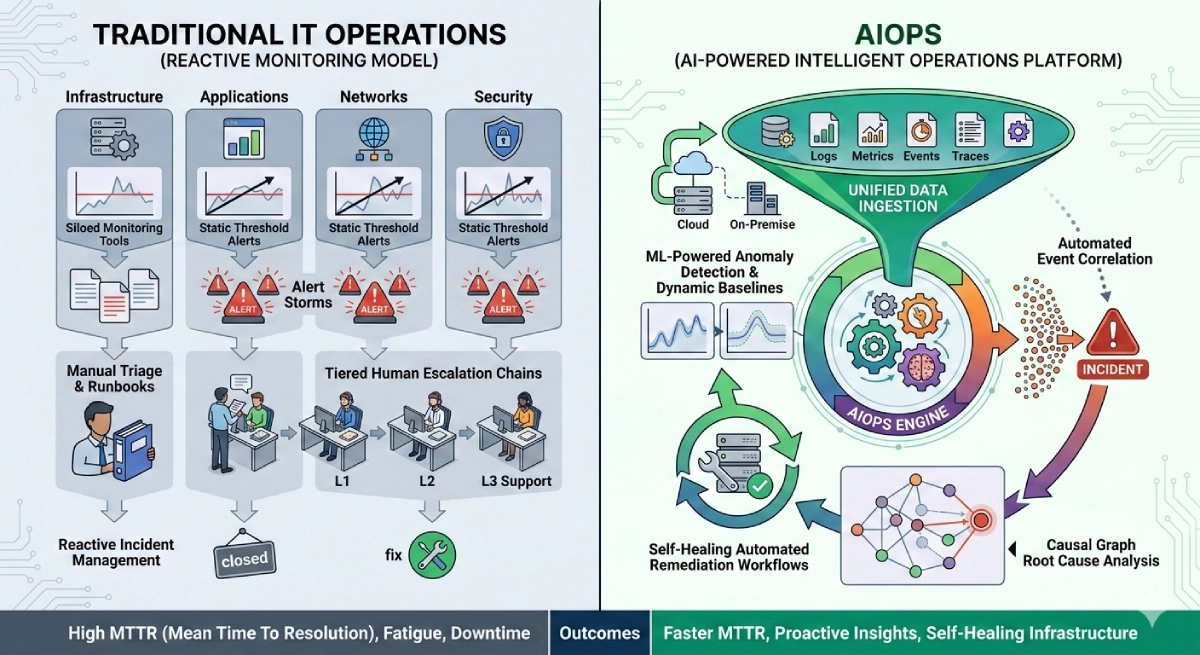
Business automation has evolved dramatically over the past decade. While traditional automation handles repetitive workflows through predefined rules, AI agents bring decision-making capabilities and adaptive behavior to the table. Consequently, the choice between AI Agents vs Traditional Automation now determines how businesses scale operations and respond to dynamic market conditions.
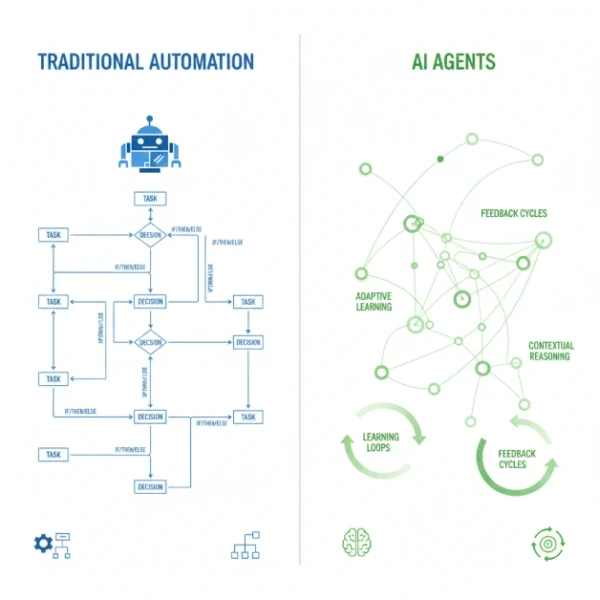
Traditional Automation: Rule-Based Processing
Definition
Traditional automation relies on Robotic Process Automation (RPA) and workflow engines that execute predefined sequences of actions. These systems follow explicit instructions programmed by developers, moving data between applications and performing repetitive tasks. Unlike their AI counterparts, they cannot deviate from their coded logic.
Advantages
- Predictable outcomes: Every execution follows the exact same path with consistent results
- Lower initial complexity: Straightforward to design and implement for well-defined processes
- Established ecosystem: Mature tools like UiPath, Blue Prism, and Automation Anywhere provide robust support
Disadvantages
- Brittle infrastructure: Breaks when source applications update their interfaces or workflows
- Limited adaptability: Cannot handle exceptions or variations outside programmed scenarios
- Maintenance burden: Requires developer intervention for every process change or edge case
Common Examples:
Invoice Processing: Extract data from PDF invoices and enter into accounting systems. Data Migration: Move records between databases following fixed mapping rules. Furthermore, Report Generation: Pull data from multiple sources and compile into standardized formats. Additionally, Email Responses: Send templated replies based on keyword matching in incoming messages.
AI Agents: Intelligent Decision-Making Systems
Definition
AI agents are autonomous software systems that perceive their environment through data inputs, make decisions using machine learning models, and take actions to achieve specific goals. Unlike traditional scripts, they reason through problems, learn from outcomes, and adjust their strategies based on results. Therefore, they can handle situations that weren’t explicitly programmed.
Advantages
- Adaptive behavior: Handles variations and exceptions without explicit programming for each scenario
- Continuous improvement: Learns from interactions and refines decision-making over time
- Complex reasoning: Processes unstructured data and makes judgment calls like human workers
Disadvantages
- Higher setup costs: Requires data infrastructure, model training, and specialized expertise
- Less transparency: Decision-making process can be opaque, making troubleshooting harder
- Resource intensive: Demands compute power and ongoing monitoring for model drift
Common Examples:
Customer Service: Chatbots that understand intent, context, and sentiment to resolve complex inquiries. Fraud Detection: Systems that identify suspicious patterns in real-time transaction data. In addition, Supply Chain Optimization: Agents that dynamically adjust inventory based on demand forecasts and supplier reliability. Moreover, Content Moderation: AI reviewing user-generated content for policy violations with nuanced judgment.
Technical Architecture Breakdown
Traditional Automation Components
- Workflow orchestration engines coordinate task sequences
- Screen scraping and UI automation tools interact with applications
- API connectors enable system integration
- Fixed decision trees execute conditional logic
- Scheduled triggers and event listeners initiate processes
AI Agent Components
- Large language models provide natural language understanding
- Reinforcement learning systems optimize strategies
- Knowledge graphs enable contextual reasoning
- Vector databases support semantic search and memory
- Monitoring systems track performance and trigger retraining
Real-World Applications and Use Cases
Ideal Scenarios for Traditional Automation
- Payroll processing: Fixed calculations with structured employee data
- Backup operations: Scheduled data transfers to storage systems
- Order fulfillment: Standard picking, packing, shipping workflows
- Compliance reporting: Generating regulatory documents from database queries
Where AI Agents Excel
- Customer inquiries: Handling diverse questions requiring contextual understanding
- Document review: Extracting insights from unstructured legal or medical documents
- Predictive maintenance: Analyzing equipment sensor data to forecast failures
- Pricing optimization: Dynamic adjustment based on market conditions and competitor analysis
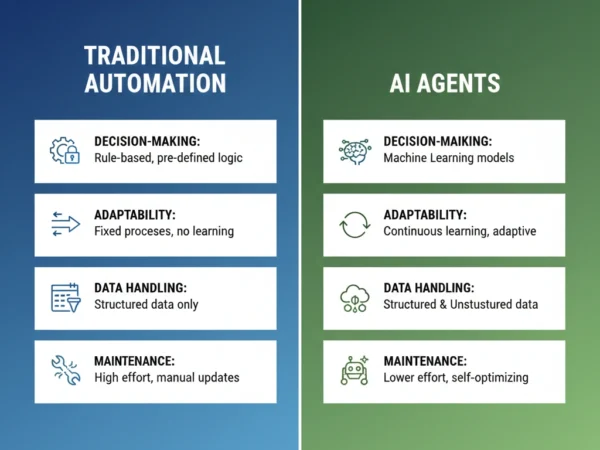
12 Key Differences: AI Agents vs Traditional Automation
Aspect | Traditional Automation | AI Agents |
|---|---|---|
| Decision Making | Follows explicit rules and conditional logic | Makes contextual decisions using machine learning models |
| Adaptability | Requires manual reprogramming for new scenarios | Learns from data and adapts to changing conditions |
| Data Handling | Works best with structured, formatted data | Processes both structured and unstructured data effectively |
| Exception Handling | Fails or stops when encountering unexpected inputs | Reasons through ambiguous situations and edge cases |
| Implementation Time | Faster initial setup for well-defined processes | Longer setup due to data collection and model training |
| Maintenance Requirements | Frequent updates needed when source systems change | Self-adjusts to minor changes, reducing maintenance overhead |
| Scalability | Linear scaling – more bots for more processes | Single agent can handle multiple related tasks intelligently |
| Cost Structure | Lower upfront costs, higher ongoing maintenance | Higher initial investment, lower long-term operational costs |
| Human-Like Understanding | No natural language comprehension or contextual awareness | Understands intent, sentiment, and nuanced communication |
| Error Recovery | Halts execution and requires manual intervention | Attempts alternative approaches and learns from failures |
| Transparency | Every step is visible and auditable in workflow logs | Decision-making process may be less transparent (black box issue) |
| Integration Complexity | Requires direct API or UI integration with each system | Can interpret interfaces and adapt to various integration methods |
Cost and ROI Analysis
Initial Investment
Traditional: $50K-$150K per process
AI Agents: $150K-$500K for infrastructure and training
Annual Maintenance
Traditional: 20-30% of initial cost
AI Agents: 10-15% of initial cost
Break-Even Timeline
Traditional: 6-12 months
AI Agents: 18-24 months
While traditional automation delivers faster ROI, AI agents provide superior long-term value. Organizations typically see 3-5x better returns after year three due to reduced maintenance costs and improved scalability. However, the choice depends heavily on your specific use case and available resources.
Migration Strategy: From Traditional to AI-Powered
Hybrid Approach Recommended
Most organizations benefit from a phased transition where traditional automation handles stable, high-volume processes while AI agents tackle complex, judgment-intensive tasks. Consequently, this balanced strategy maximizes ROI while minimizing risk.
Assessment Criteria
Move to AI When:
- Process involves unstructured data analysis
- Frequent exceptions require human judgment
- Market conditions change rapidly
Keep Traditional When:
- Process is highly standardized and stable
- Inputs are structured and predictable
- Regulatory requirements demand full auditability
Implementation Phases
- Phase 1 (Months 1-3): Begin by auditing existing automation and identifying candidates for AI enhancement
- Phase 2 (Months 4-6): Next, pilot an AI agent on one high-impact use case
- Phase 3 (Months 7-12): Subsequently, scale successful pilots and integrate with legacy systems
- Phase 4 (Months 13+): Finally, optimize hybrid architecture and sunset redundant traditional bots
Practical Implementation Guide
Code Examples
Traditional RPA Script (Python)
from selenium import webdriver

driver = webdriver.Chrome()
driver.get('https://example.com/login')

# Fixed sequence of actions
driver.find_element_by_id('username').send_keys('user')
driver.find_element_by_id('password').send_keys('pass')
driver.find_element_by_id('submit').click()

# Extract data from specific element
data = driver.find_element_by_class_name('result').text
print(data)
AI Agent Implementation (Python)
from langchain.agents import create_react_agent
from langchain_openai import ChatOpenAI

llm = ChatOpenAI(model="gpt-4", temperature=0)

agent = create_react_agent(
    llm=llm,
    tools=[browser_tool, database_tool],
    prompt=agent_prompt
)

# Agent decides how to accomplish goal
result = agent.invoke({
    "input": "Extract Q4 revenue from company portal"
})

print(result['output'])
Selection Framework
- Process Complexity Assessment: First, map out decision points, exception scenarios, and data variability in your target process.
- Data Availability Review: Then, evaluate whether you have sufficient historical data to train AI models effectively.
- Risk Tolerance Evaluation: Additionally, determine acceptable error rates and whether decisions need human verification.
- Resource Planning: Furthermore, estimate compute requirements, staffing needs, and infrastructure investments.
- Vendor Selection: Subsequently, choose between building custom agents or using platforms like Microsoft Copilot, Google Vertex AI, or AWS Bedrock.
- Success Metrics Definition: Finally, establish clear KPIs including accuracy, processing time, cost per transaction, and user satisfaction.
Best Practices
Do’s
- Start with narrow, well-defined use cases for AI agents
- Maintain human oversight loops for critical decisions
- Version control your automation logic and training data
- Monitor model performance continuously for drift
Don’ts
- Don’t deploy AI agents for compliance-critical tasks without extensive testing
- Avoid training on biased or incomplete datasets
- Don’t eliminate traditional automation just because AI is trendy
- Never skip explainability when decisions impact customers
Frequently Asked Questions: AI Agents vs Traditional Automation
Making the Right Choice for Your Organization in 2026
The decision between AI Agents vs Traditional Automation isn’t about choosing one over the other—it’s about deploying the right technology for each specific use case. As we move through 2026, successful organizations are building hybrid automation strategies that leverage both approaches strategically.
Choose Traditional Automation When:
- Process steps are highly standardized and stable
- Inputs are structured and follow consistent formats
- Full audit trails and explainability are mandatory
- Quick deployment is critical (weeks not months)
- Volume is high but complexity is low
Choose AI Agents When:
- Process involves significant judgment or decision-making
- Inputs are unstructured (documents, emails, images)
- Exceptions and edge cases are common
- Requirements change frequently due to market dynamics
- Natural language understanding is required
Strategic Recommendation:
Start by automating your most stable, high-volume processes with traditional RPA to generate quick wins and build automation culture. Simultaneously, pilot AI agents on one complex use case where human judgment is currently required. This parallel approach lets you learn both technologies while delivering measurable business value. Furthermore, as your data infrastructure matures and team expertise grows, gradually expand AI agent deployments to more sophisticated scenarios.
The automation landscape in 2026 rewards organizations that understand these technologies aren’t competing solutions but complementary tools. Ultimately, your competitive advantage comes from knowing which approach fits each challenge and building the infrastructure to support both seamlessly.
Related Topics Worth Exploring
Machine Learning Operations (MLOps)
Discover how to deploy, monitor, and maintain AI models in production environments at scale.
Intelligent Process Automation
Explore hybrid approaches that combine RPA, AI, and workflow orchestration for maximum impact.