CMM (Capability Maturity Model) is a software-specific framework from the SEI that grades an organisation’s software process across five maturity levels, so it is an improvement model that gives a maturity grade. ISO 9000 is a family of generic international quality management standards that any industry can adopt, and it is certification-based, so an audit gives a pass or fail. In short, CMM measures how mature your software process is, while ISO 9000 certifies that your quality system meets a standard.
CMM and ISO 9000 are two well-known approaches to managing quality, and software-engineering syllabuses compare them often. Both push an organisation toward better, more reliable processes. Yet students frequently blur their scope, their structure, and how each one is assessed. So a clear comparison helps a lot.
The core difference is simple. CMM is a staged maturity model built for software, while ISO 9000 is a general-purpose quality standard for any business. This guide defines each one, lays out the five CMM levels, compares the two in detail, and shows when each fits. If you want the wider picture first, browse the CS Fundamentals hub.
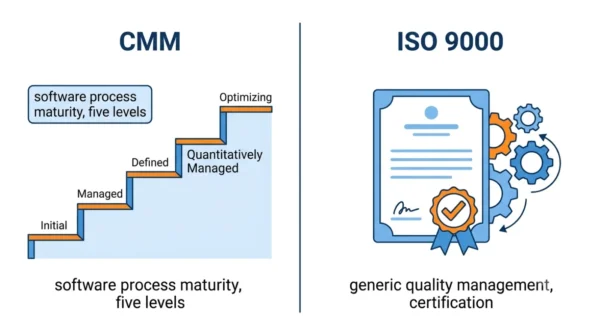
What is CMM?
CMM stands for Capability Maturity Model. The Software Engineering Institute (SEI) at Carnegie Mellon University developed it, so it targets software organisations directly. So it assesses and refines the processes a team uses to build and maintain software.
The central idea is maturity. Indeed, an organisation evolves through five levels, moving from chaotic, unpredictable work toward a well-defined and optimised process. Therefore CMM does not simply pass or fail you. Instead, it places you on a maturity grade and shows the next step up. CMM is the predecessor of CMMI, its broader successor.
Advantages of CMM:
- Tailored for software, so it speaks directly to engineering activities.
- A clear maturity grade, which shows exactly where a team stands.
- A staged path, because each level builds on the one below.
- Strong focus on measurable, repeatable process improvement.
Disadvantages of CMM:
- Narrow scope, since it suits software more than general business.
- Reaching the higher levels takes time, effort, and discipline, since each step demands more.
- Heavy documentation, which can feel bureaucratic for small teams.
The Five Maturity Levels
CMM defines five staged levels, and an organisation climbs them one at a time. For example, the list below keeps the original descriptions and adds the standard level names.
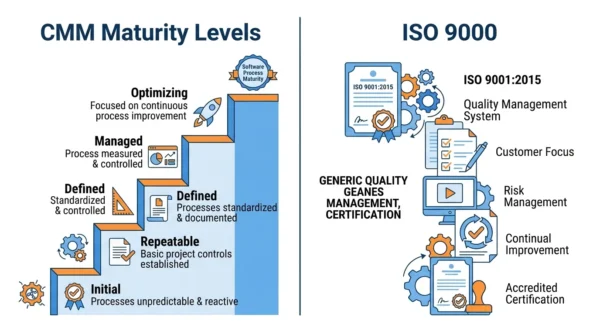
- Initial: processes are ad hoc and unpredictable, so success depends on individual heroics.
- Repeatable: basic project management is in place, so teams can repeat earlier successes on similar work.
- Defined: processes are well characterised, documented, understood, and proactive, so the whole organisation follows them.
- Managed (Quantitatively Managed): processes are controlled using statistical and quantitative metrics.
- Optimizing: the focus shifts to continuous process improvement driven by feedback and data.
So the journey runs from chaos at level one to constant refinement at level five. Each step demands more discipline, yet each step also makes delivery more predictable.
What is ISO 9000?
ISO 9000 is a family of international standards for quality management and assurance. The International Organization for Standardization publishes it, and any industry can adopt it. Rather than targeting software, it gives a generic framework that emphasises customer satisfaction and continuous improvement.
Within the family, ISO 9001 holds the certifiable requirements for a Quality Management System (QMS). An organisation gets audited against those requirements, so the outcome is a pass-or-fail certification rather than a maturity grade. ISO 9000 rests on core quality-management principles, including customer focus, leadership, engagement of people, the process approach, evidence-based decision-making, and relationship building. Moreover, it stresses managing interrelated processes and improving them continually.
Advantages of ISO 9000:
- Industry-agnostic, so any business can apply it.
- Globally recognised, because the certification carries weight worldwide.
- Strong customer focus, which builds trust and satisfaction.
- A clear QMS foundation for ongoing, continual improvement.
Disadvantages of ISO 9000:
- Generic by design, so it gives less software-specific guidance.
- Certification and audits add recurring cost and effort, so budgets feel it.
- A pass result shows compliance, yet it does not grade maturity.
CMM vs ISO 9000: Comparison Table
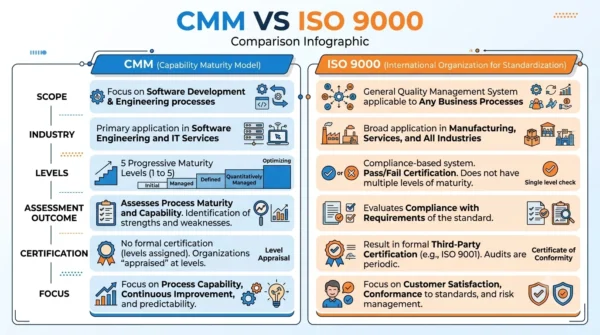
| Aspect | CMM | ISO 9000 |
|---|---|---|
| Full form | Capability Maturity Model | ISO 9000 quality standards family |
| Developed by | Software Engineering Institute (SEI) | International Organization for Standardization (ISO) |
| Primary scope | Software industry specifically | Standards for all types of industries |
| Type | Process maturity / improvement model | Quality management system standard |
| Assessment outcome | Provides a grade for process maturity | Provides pass-or-fail criteria |
| Levels | Five maturity levels | No levels |
| Main focus | Software engineering activities | Corporate business processes |
| Structure | Staged, level by level | Requirement-based clauses |
| Certifiable standard | SEI appraisal, not a certificate | ISO 9001 holds the requirements |
| Goal | Improve and mature the process | Assure consistent quality |
| Customer focus | Indirect, through better process | Direct and central principle |
| Improvement model | Continuous via higher levels | Continual improvement principle |
| Applicability | IT and software organisations | Manufacturing, services, and more |
| Successor | CMMI replaced and extended it | Revised periodically, such as ISO 9001:2015 |
| Typical users | Software firms and IT teams | Businesses across every sector |
How CMM and ISO 9000 Are Assessed
The clearest contrast shows up in assessment, so picture one software company under each approach.
Under CMM, an appraisal looks at how the team plans, tracks, and improves its software process. The result is a maturity level, for example level 3 (Defined). Because the model is staged, the company then knows the practices it must add to reach level 4. As a result, the grade doubles as a roadmap for the next improvement.
Under ISO 9000, an external auditor checks the quality management system against the ISO 9001 requirements. If the QMS meets them, the company earns certification; if not, it does not. So the outcome is a clear pass or fail rather than a sliding grade. Many organisations actually pursue both, since ISO certification proves quality assurance while CMM drives software process maturity.
When to Use CMM or ISO 9000
You rarely choose blindly, because the scope of each one points the way.
Choose CMM when software is the core of your work. Its maturity levels guide IT and software organisations toward a systematic, measurable approach to development and maintenance. Therefore it fits teams that want to mature their engineering process step by step.
Choose ISO 9000 when you need a broad, internationally recognised quality standard. It suits any industry, since it builds, implements, maintains, and continually improves a general QMS. Before deciding, run a needs assessment that weighs your industry, your project requirements, your budget, your resources, and the expected return. In many cases the smart move is both, with ISO 9001 for certification and CMM for software maturity.
Interview Questions
Frequently Asked Questions
Wrapping Up
CMM and ISO 9000 chase the same outcome from different angles. CMM grades and matures a software process across five staged levels, while ISO 9000 certifies a generic quality management system for any industry.
Remember the simple rule: CMM measures software process maturity, and ISO 9000 certifies quality. Whether you pursue the structured levels of CMM or the recognised standards of ISO 9000, the goal stays the same, namely better quality, stronger processes, and happier customers. So align the choice with your organisation’s needs, and you will answer most exam and interview questions on the two.
Related reading on DiffStudy: