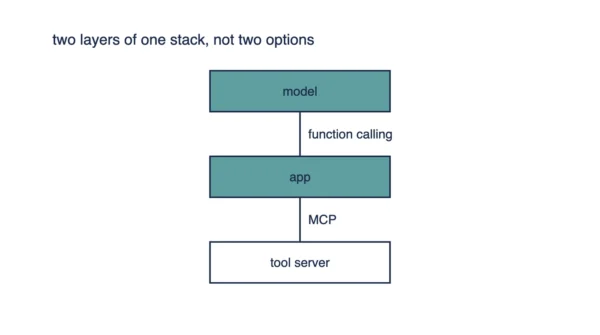
MCP (Model Context Protocol) vs function calling is not a choice between two rivals. Function calling is a capability of the model’s application programming interface (API). The application sends tool definitions with the request. Then the model returns a structured call. It does not execute anything on its own, though. Your code runs the function, then sends the result back. MCP is a separate, open protocol instead. It connects an application to a tool server, so tools get discovered at runtime rather than hardcoded. The two sit at different layers of one flow instead. A system built on MCP still needs function calling, since that is how the model expresses which tool it wants. MCP decides where that call actually goes. It still does not replace function calling. It does not ship audit trails or approval workflows either. The specification only recommends a human in the loop instead. You still have to build that enforcement yourself.
MCP and function calling show up in the same paragraph constantly. In fact, some guides even use the terms interchangeably. That habit hides a real distinction developers need before they wire either one into an app.
This guide keeps the explanation concrete. It shows what each layer actually does, in what order, and where they meet. A worked five-step flow ties the two together near the end.
MCP also gets compared to a second protocol, Agent2Agent, in MCP vs A2A. That guide goes deep on protocol mechanics: client, server, discovery, transport. This one stays narrower instead. It measures MCP against the model’s own function-calling capability, not against another protocol.
The Problem Each One Solves
A large language model (LLM) cannot act on its own. It reads text and predicts more text. Nothing about that loop touches a database, a file system, or a live API. Two different gaps sit between a model and the outside world, and each one needs its own fix.
The first gap is expression. A model needs a structured way to say what it wants done, not just a plain-English guess. So function calling fills that gap. It gives the model a fixed vocabulary of tools and a strict format for naming one.
The second gap is reach. An application still has to find the right tool. It needs the schema, then it calls the tool correctly. That often spans many different tools and services. MCP fills that gap instead. It gives an application one standard way to discover and call tools that live behind a server.
Confusing the two gaps causes most of the mix-up. Function calling solves how a model expresses a request. MCP solves how an application finds and reaches what that request points to. Neither one covers what the other already does, though.
How Function Calling Works
Function calling, also called tool calling, is a capability of the model’s API. It is still not a separate protocol. It is a feature the model provider builds directly into the request and response format.
The application sends a list of tool definitions with each request. Each definition carries a name, a plain description, and a JSON Schema for its parameters. The model reads those definitions alongside the conversation.
When the model decides a tool fits, it does not run anything itself. Instead, it returns a structured request naming the tool and supplying arguments that match the schema. The application still has to execute the actual function.
That execution happens in your code, not inside the model. Your application runs the function, then sends the result back to the model as part of the next turn. The model reads that result and continues the conversation from there.
Field names differ by provider, and the exact JSON shape is not identical everywhere. The underlying pattern stays the same everywhere, though. Definitions go in. A structured call comes out. Your code executes it, and the result goes back in. Sampling settings such as those compared in temperature vs top-p shape the model’s own text; they never touch this loop.
How MCP Fits
MCP is an open integration protocol, not a model feature. Any model can use it, since it is model-agnostic by design.
The architecture is client-server. A host application runs an MCP client for each connection. An MCP server, on the other side, exposes tools, resources, and prompts. Messages travel as JSON-RPC 2.0, a lightweight remote-procedure-call format encoded in JSON.
Discovery happens at runtime, not at build time. A client sends a tools/list request. It gets back whatever tools the server currently offers, each with a JSON Schema. It then calls one with tools/call.
One server can serve many applications instead. Wrap a tool once as a server. Every MCP client that connects can then reach it, regardless of which model sits behind that client.
That reusability is the actual point of the protocol. The deeper mechanics, client, server, transport, and discovery, live in MCP vs A2A, which compares MCP against a second agent protocol instead of against function calling.
MCP vs Function Calling: Comparison Table
| Aspect | Function Calling | MCP |
|---|---|---|
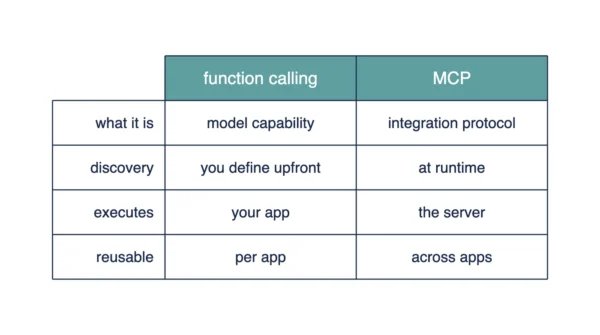
| What it is | A capability of the model’s API | An open integration protocol |
| Who defines the tools | The application, in its own request | An MCP server, behind its own boundary |
| Where definitions live | Sent fresh with every request | Hosted on the server, fetched on demand |
| How tools are discovered | Passed directly by the app | Runtime tools/list request |
| Point in the flow | Between the app and the model | Between the app and the tool server |
| Who executes the tool | The application’s own code | The MCP server |
| Reusability across apps | Tied to that one app’s code | One server, many clients |
| Model dependence | Field names vary by provider | Model-agnostic by design |
| Transport | The provider’s own API request format | JSON-RPC 2.0 over stdio or streamable HTTP |
| Adding a new tool | New code in every app that needs it | Add it once, on the server |
| Adding a new application | Rebuild every tool integration again | Implement one client, reuse every server |
| Integration effort at scale | Grows as apps times tools | Grows as apps plus tools |
| Security posture | Whatever the app builds itself | Spec recommends human-in-the-loop; enforcement is still on you |
| Usable without the other | Works standalone, no MCP required | Still needs function calling to reach the model |
They Work Together, Not Instead
Here is where the two layers actually meet. A system that uses both runs through five steps, in a fixed order, every time the model needs a tool.
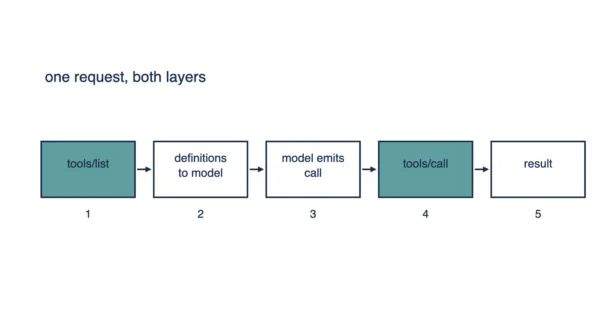
- The MCP client calls tools/list on an MCP server. It gets back tool definitions, each carrying a JSON Schema.
- The application passes those definitions to the model, using the provider’s function-calling mechanism.
- The model emits a function call, naming a tool and its arguments.
- The application routes that call to the MCP server as tools/call.
- The server executes the call and returns a result. That result goes back into the conversation.
Notice what each layer contributes. Function calling is how the model expresses intent. It names a tool and supplies arguments in a structured shape. MCP is how the application finds and reaches that tool in the first place.
So you still need function calling when you use MCP. MCP still does not remove that step. It feeds it instead. Several pages online imply otherwise, and that is simply wrong.
Think of it as one stack, not two competing options. The model never talks to the MCP server directly. The application sits in the middle the whole time. It translates between a function call and a tools/call.
The N times M Problem
Without a shared protocol, connecting N applications to M tools means writing N times M integrations. Each application implements every tool itself, one integration at a time.
For example, three applications might each need five tools. That is fifteen separate integrations, and none of them carry over between apps.
A shared protocol changes the shape of that math instead. Wrap each tool once as a server, and each application implements the client once. The total work becomes N plus M instead.
That is the actual argument for MCP. It has nothing to do with whether a model can call functions. A model has always been able to do that, given the right API.
What MCP Does and Does Not Give You
Several pages claim MCP ships approval and audit features out of the box. That overstates what the spec actually does.
Here is what is true. The MCP specification still recommends that clients keep a human in the loop. It says there SHOULD always be a way to deny a tool invocation. It also recommends showing tool inputs to the user before calling one.
Those are recommendations aimed at client implementers, not controls the protocol enforces. Nothing in MCP stops a client from skipping that check entirely, though. The specification cannot make an implementation compliant on its own.
Something else is also true, though. Because tools live behind a server boundary, you get a natural place to put authentication, logging, and policy. That boundary is real, and it is useful.
But you have to build all of it yourself. MCP gives you the seam, not the enforcement. Adding a server boundary also means trusting a new party. The server itself becomes a new consideration, not a free win.
When You Need Which
Reach for function calling whenever a model needs to act, full stop. Every agentic flow uses it somewhere, whether or not MCP sits underneath.
Instead, reach for MCP once tools need reuse across applications. It also fits once tools live behind a server you do not control directly. A single script calling one local function may not need MCP at all.
Frameworks that wrap this plumbing, compared in LangChain vs LlamaIndex, still sit on top of both layers. Neither framework replaces function calling or MCP, though. Each one just makes the wiring easier to write.
Handing a model fresh knowledge is a related but separate question, covered in retrieval-augmented generation vs fine-tuning. That question is about what the model knows, not about which actions it can trigger.
Most production systems end up using both anyway. Function calling handles how the model expresses a request. MCP handles how that request reaches a growing set of tools without new code every time.
Interview Questions
Frequently Asked Questions
Wrapping Up
MCP vs function calling is not a real rivalry. Function calling is a capability built into the model’s API. MCP is a separate, open protocol for reaching tools that live behind a server.
Keep the five-step flow close. The MCP client lists tools, the application hands their definitions to the model through function calling, the model emits a call, and the application routes it back to the server as tools/call.
So the honest framing is layering, not competition. Function calling is how a model expresses intent. MCP is how an application finds and reaches what that intent points to. Treat them as one stack, and the confusion mostly disappears.
Related reading on DiffStudy:
- MCP vs A2A: Agent Protocols
- LangChain vs LlamaIndex
- Temperature vs Top-p
- Retrieval-Augmented Generation vs Fine-Tuning
- CS Fundamentals hub